
展讯|心师目:秋麦艺术展
For English Please Scroll down
主办:三影堂+3画廊
策展人:箫岭 (Nataline Colonnello)
开幕:2018年9月23日 17:00
讲座:2018年10月13日 16:30
展期:2018年9月23日 – 11月25日
(周一闭馆)
地点:三影堂摄影艺术中心
(北京市朝阳区草场地155A)

三影堂+3画廊很荣幸举办艺术家秋麦十年来在北京的首次个展《心师目:秋麦艺术展》。几十年来沉浸在中国的生活和文化中,秋麦的摄影作品中充满了与中国传统艺术交流的活力。观看的同时,也仿佛随着作品穿越了中国地理和艺术的历史。
秋麦的摄影集中对于山水的描绘,根据景观和集体文化记忆之间的联系而选择创作的对象。秋麦将诗意、绘画与他对环境问题的浓厚兴趣融为一体,并将自己长期置于其中。
秋麦的作品通常从中国三种传统艺术 - 诗歌、绘画和书法 - 引发的主题开始。此后,秋麦投身于一个漫长的研究,这最终使他得以跟随几个世纪前的前辈的足迹亲身游历。
他使用带有广角镜头的Leica M6或富士XPAN及35mm胶片拍摄作品,通常以黑白为主。只有极少作品最终通过了他精细的筛选。秋麦根据概念、美学和形式上的标准,裁剪、放大了一部分图像。这些标准具体包括:实景细节与水墨画中笔触的相似性,整体构图的节奏,以及作品预期的呈现形式-或横或竖的卷轴、册页、屏风或木框装裱的照片等。
最终作品以在宣纸或三桠皮纸上喷墨输出的方式呈现。这些纸张通常用于书法和水墨画创作,未经化学处理,纸张表面根据其固有的结构特性自然吸收墨水。构成传统风景画独特笔触的三要素-笔速、笔力和水量,在此被打印机的机械运作和墨滴代替。
对于像秋麦这样的行家来说,摄影只是构成其最终作品的一部分,除此之外还包括精致的装裱、书法题字、印章。如果作品是以卷轴或册页的方式呈现,还会将其存放在由顶级木材制作的手工盒中,最终成为一件完整的作品。
根据作品在颗粒感和抽象性上的差异,秋麦选取了在过去十年中创作的12件作品放入此次展览。其中许多作品首次在中国、甚至世界范围内展出。
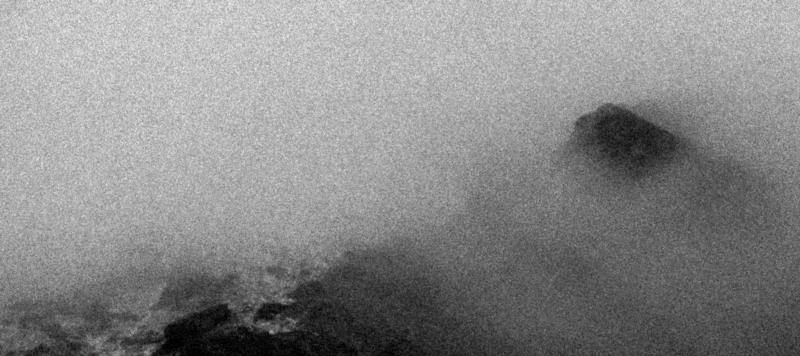
《山海图 #10》, 2012,摄影墨本、三桠皮纸,42cm x 75cm (画心 image 21cm x 47cm)
Map of Mountains and Seas #10, Photographic print on Mitsumata Paper
展出作品包括《山海图》系列,创作灵感源于4世纪中国经典《山海经》中的真实或神话景观。这些作品中的每一件都附有GPS坐标和方位,用于证明全景的存在,为观察者提供了观察视野的精确点。通过技术手段,如消除地平线(山海图 #19, 2012),极端放大倍率(山海图 #10, 2012),或重复推进摄影胶片(山海图 #15, 2012,拍摄于加拿大),这个系列作品中的风景获得了一个永恒的、静谧的、变革性的美学维度。
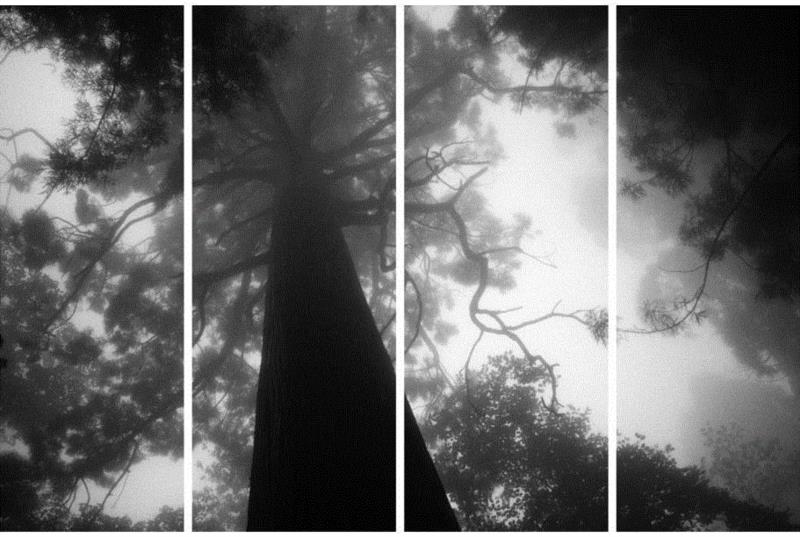
《影幔 #8B》 , 2010,摄影墨本、三桠皮纸,130 x 206 cm
Shadow Curtains #8B, Photographic print on Mitsumata Paper
《影幔 #8B》是一幅描绘江西庐山古树的大型作品。从雄伟的树干底部看去,其被薄雾笼罩的树叶仿佛成为超越时间的证据。这也是对17世纪日本艺术家俵屋宗达的四折屏风作品《风神雷神图》的致敬。
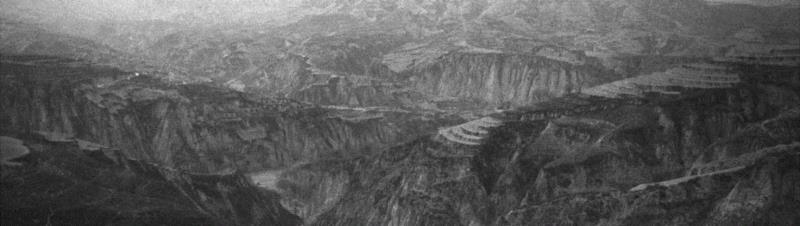
《黄土三景 (横 #1)》, 2009,摄影墨本、三桠皮纸,58 x 204 cm
Three Views of Yellow Earth (Horizontal #1 ), Photographic print on Mitsumata Paper
在《黄土三景》中,秋麦行至中国北方的黄土高原,干旱和被侵蚀的地表显露了人类生活散落的痕迹和土地开发的百年历史。

《鹤势》, 2007,手卷、摄影墨本、美浓楮纸,25 x 1337 cm,
Twilight Cranes Handscroll, photography, ink on Mino kozo paper
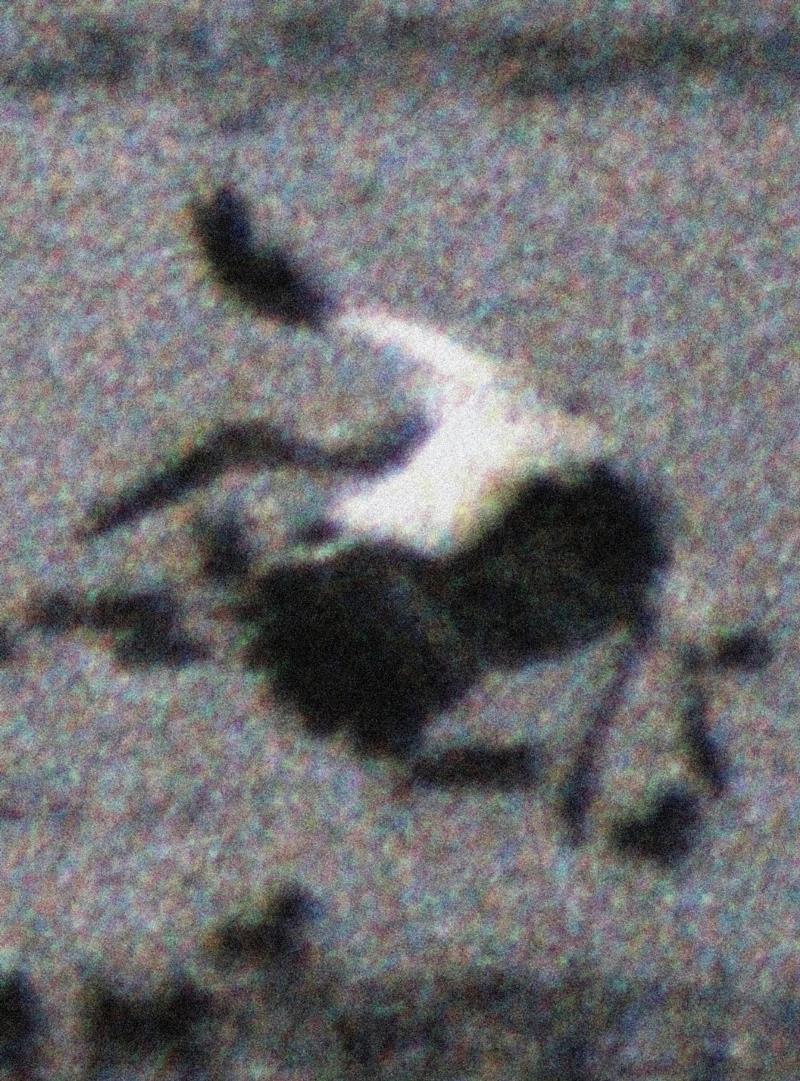
《鹤势》局部 Detail of Twilight Cranes
《鹤势》是一幅25x1337cm的优美手卷,印在精良的美浓楮纸上,描绘了江西鄱阳湖地区越冬的鹤群。在中国神话中,鹤象征性地与不朽的观念联系在一起,这里的鹤群看起来模糊不清。由于其生活的自然栖息地被人为破坏而产生的不可逆转的恶性后果,它们未来在物质世界中的存在变得格外艰难。这部作品受到17世纪日本巨作《鹤下绘和歌卷》的启发,此手卷保存在京都国立博物馆,为本阿弥光悦书写,俵屋宗达绘图。这里秋麦在创作阶段上发生的转变,一方面是被日本作品影响激发的灵感,另一方面则是受到了中国石刻杰作《瘗鹤铭》的裂缝的启示。刻有为亡鹤而做的悼词的石碑,可以追溯到南朝时期(420-589)。1713年,石碑在落水百年后被打捞而出,直到今天,它仍将其文字隐喻的信息传递给后人:铭文中的鹤象征了石刻年代被压迫的道教。
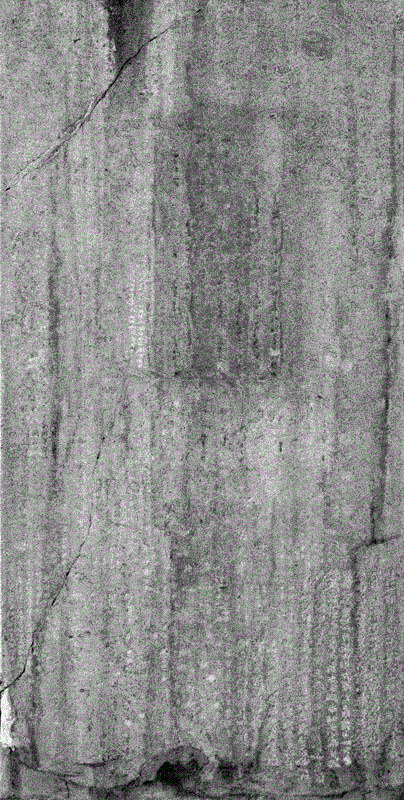
《无字碑》,2007,摄影墨本、仿宣棉纸,416 x 210 cm
Wordless Stele, Photographic print on xuan style cotton paper
《无字碑》是一幅巨大的摄影作品,耸立在展厅主墙的中心。该作品采用特殊的轻型结构装裱,加强了其与原碑的内在对比,凸显了其独特的象征意义和历史时期。作品拍摄的是唐代女皇帝武则天(625-705)逝世后陕西乾陵竖立的纪念石碑,和原碑一样大。碑上无唐字,题刻大部分是在宋、金时期完成。然而,随着时间的推移,现在这些文字只是部分可读。在可读性和抽象性之间的精妙平衡中,从远处观看秋麦《无字碑》似乎可读,但观察者越接近作品,过去留下的信息越模糊。
秋麦简介
1969年出生于纽约,现居北京
秋麦毕业于纽约州立大学宾汉顿校区,主修中国文学和历史,后至北京语言学院进修中文。后自学摄影和中国艺术史。秋麦的学术背景和对中国艺术史的钻研使得他对中国山水画传统心怀永久的欣赏与敬意。秋麦居住于北京二十余年,通过摄影旅行广泛游历了中国大地。在跋涉中,他不断寻找和艺术史有关的古迹、地点, 旨在 “凝望着一个承载着广大的(有时令人生畏的)历史和文化记忆的地方,用摄影来捕捉它的某个瞬间, 虽转眼即逝,却也真实存在。”
秋麦的作品是第一个进入美国大都会艺术博物馆亚洲部收藏的摄影作品, 并已被其它多家国际艺术博物馆永久收藏,其中包括克利夫兰艺术博物馆、纳尔逊艺术博物馆、盖蒂研究院、哈佛大学艺术博物馆赛克勒博物馆、普林斯顿大学艺术博物馆、耶鲁大学美术馆、洛杉矶郡立美術館、皮博迪埃塞克斯博物馆、波特兰艺术博物馆、圣路易斯艺术博物馆、圣芭芭拉艺术博物馆等。
Organizer:Three Shadows +3 Gallery
Curator: Nataline Colonnello
Opening: 17:00, September 23rd, 2018
Lecture:16:30, October 13rd, 2018
Duration: September 23rd – November 25th, 2018 (10:00-18:00 Closed on Mondays)
Location: Three Shadows Photography Art Centre
(155A Caochangdi, Chaoyang District, Beijing 100015)
Three Shadows +3 Gallery is honored to host Michael Cherney's first solo show in Beijing in over ten years, "The Heart-Mind Learns From the Eyes – The Art of Michael Cherney." Resulting from decades of immersion in Chinese life and culture, Cherney's photographic works exist in vibrant conversation with the unbroken tradition of Chinese art. To see them is also to travel through the geography and history of the country.
Cherney’s photography centers on depictions of landscapes that he selects according to their associations with collective cultural memory. He embeds poetic and pictorial references alongside his deep interest in environmental issues, situating himself in a long continuum.
The photos often start with subject matter stirred by three of China's traditional arts – poetry, painting, and calligraphy. Cherney then engages himself in a long research process that culminates in journeys to the landscapes revered and immortalized in the work of his predecessors.
Cherney photographs with the wide-angle lens of his Leica M6 or Fuji XPAN on 35mm film, often in black-and-white. Only a few frames pass his meticulous edit. He then crops and magnifies a slice of the image according to conceptual, aesthetic and formal criteria, such as the actual resemblance of the subject to the brushstrokes in the inspirational ink-and-wash painting, the overall compositional rhythm, and the intended presentation of the photograph – a vertical or horizontal scroll, an album, a screen, a photograph in a wooden frame, etc.
The final result is an ink-jet photograph printed on traditional paper normally used for calligraphy and brush painting, generally Xuan or Mitsumata paper. Left untreated with chemicals, the surface absorbs the ink naturally according to its intrinsic structural qualities. The speed, pressure and amount of water that form the distinctive character of traditional brushwork landscape painting are replaced by mechanically propelled ink droplets.
To a connoisseur like Cherney, photography constitutes only a piece of the final artwork. He creates full objects featuring sophisticated mounting, calligraphy, special seals, and – in the case of the scrolls or accordion fold albums he creates – a refined, handcrafted box realized with the finest Chinese woods.
Varying in their level of grain and abstraction, Cherney created the twelve works featured in this exhibition over the past decade. This is the first time for any of these works to be shown in China; many have never been exhibited anywhere.
The selected pieces include works from the series The Map of Mountains and Seas inspired by the real or mythological landscapes featured in the 4th Century Chinese classic The Classic of Mountains and Seas (Shan Hai Jing). Each of these works is accompanied by GPS coordinates and an azimuth testifying to the material existence of the panorama, giving observers an exact point for looking at the vista. By means of canny technical gambits like the elimination of the horizon (Map of Mountains and Seas #19, 2012), extreme magnification (Map of Mountains and Seas #10, 2012), or repeated partial advancement of the photographic film (Map of Mountains and Seas #15, 2012, photographed in Canada), the landscapes in this series acquire an atemporal, silent, and transformative aesthetic dimension.
Shadow Curtains #8B (2010, 130x206cm) is a large format work depicting one of the three ancient trees on Mount Lu in Jiangxi Province. Seen from the bottom of the majestic trunk, the tree and its mist-shrouded foliage become otherworldly evidence of a revered past. It is a four-panel photographic homage to the 17th century painting Wind God and Thunder Godby Japanese artist Tawaraya Sōtatsu.
In Three Views of Yellow Earth, Cherney moves to the Loess Plateau in Northern China. The dry and eroded territory exposes scattered traces of human life and a centuries-long history of land exploitation.
Twilight Cranes (2007), meanwhile, is a delicate 23x1337cm handscroll printed on fine kozo paper from Mino (Gifu Prefecture, Japan) that portrays the cranes in the Poyang Lake region of Jiangxi. Symbolically connected with the idea of immortality in Chinese mythology, the cranes here look blurred and ephemeral, their future existence in this physical world suspended in daunting uncertainty by the irreversible deterioration of their natural habitat caused by man. This work is formally inspired by the 17thcentury Japanese masterpiece Poems of the Sanjūrokkasen with Design of Cranes, a 34x1356cm handscroll preserved at the Kyoto National Museum that combines some of the finest calligraphy by Hon'ami Koetsu with the exquisite brushwork of Tawaraya Sōtatsu.
Cherney's work also alludes to the cracks on the Chinese stone engraving masterpiece Yi He Ming (aka "Inscription of a Eulogy on the Burial of a Crane"), a stele dating back to the Southern Dynasties (420-589). Spared from oblivion, in 1713 the stele was hauled out of waters in which it fell centuries before, preserving its literal and metaphorical messages until today – the crane could stand for Daoism, which was oppressed at the time of the stone inscription.
Wordless Stele (2007, 416x210cm) is a monumental photographic work towering in the middle of the exhibition space. Mounted with special lighting that enhances its already palpable contrast, symbolic meaning, and peculiar history, the work is a full (1:1) scale photographic reproduction of the commemorative stele erected in Qiangling, Shaanxi Province after the death of Tang Dynasty Empress Wu Zetian (625-705). Nowadays its engravings are only partially readable. Achieving an exquisite balance between legibility and abstraction, Wordless Stele seems readable from afar, yet the closer the observer comes to the work, the more fuzzy and indistinct the messages left from the past become.
About Michael Cherney

 {{newsData.good_count}}

 {{newsData.transfer_count}}


 {{item.good_count}}k
已展示全部
{{item.publisher_name}} 发布了 文章
{{item.title}}
更多功能等你开启...


 分享
分享