Beauties in Qing Court Art—— on Jiao Bingzhen’s Album of Classic Ladies
摘要:焦秉贞是满洲贵族统治下的清代宫廷画师,其代表作《仕女图册》以高度装饰性的风格展现了清代宫廷仕女画在视觉享乐主义上的一个高峰。女性作为男权制度下的视觉享乐载体,是贯穿中国历代仕女画的一个共同特征。但除此之外,焦秉贞《仕女图册》的重要性在于其中蕴含了诸多跨文化的要素,包括西洋绘画技法在宫廷艺术中的运用、南方文人画传统与满洲审美的结合等。与此同时,在单纯的视觉观看之外,《仕女图册》中的女性形象还体现出了汉文化与清代政治统治之间种种复杂微妙的关系。本文以《仕女图册》为例,希望进一步探究清代宫廷仕女画在图像释义上的转变,从而更好地界定此作品在特定的历史语境中所发挥的审美功能与政治功能。文章来源:本文原载《国际比较文学》(International Comparative Literature)2019年第2期,公众号发文略有修改。
The year 1644 marks a new period of China, when the Manchu took over Chinese land from Ming loyalty and established Qing. The Manchu rulers have set up a unique pictorial language that could be seen in their splendid court art. When reflecting court art in Chinese history, the Qing court art has reached a peak in the development of the highly decorative, flamboyant style, especially in the reigns of Kangxi康熙(r.1662-1722), Yongzheng雍正 (r.1723-1735) and Qianlong 乾隆(r.1735-1796). By absorbing western painting techniques brought by the European Jesuits, including Chinese cultural marks and also retaining Manchu’s tradition at the same time, the Qing rulers made their court art highly recognizable with the distinct style of crossing-cultural elements, which forms a new cultural identity in Chinese history.

Giuseppe Castiglione,The Qianlong Emperor in Ceremonial Armor on Horseback,c.1758
Among the various artists who served the Qing court and contributed to its prosperity, Jiao Bingzhen (c. 1650-after 1726) was one of the earliest painters who studied western science and adopted western painting style in his artworks.[1] Born in Jining, Shandong province, Jiao began his court career by serving in the Directorate of Astronomy, where he came in contact with the famous scientist Ferdinand Verbiest (Nan Huairen南怀仁, 1623-1688) who was recorded to have been working in the same department.[2] The assistant work in the technology-leading bureau provided him with an excellent opportunity to learn science and technology from the western missionaries. It was probably this experience that helped him to become a pioneer among the fine masters in western perspective and drawing.[3] Due to Kangxi’s personal interest in western science and technology, Jiao Bingzhen was promoted as a scholar official after Kangxi’s praise on his accurate calculation in creating an illusionistic space in painting.[4] His skillfulness in the use of western painting methods made him a prominent court painter who became qualified to paint important court works such as Farming and Sericulture耕织图, through which he gained high comments of his contemporary that “his work gives the effect of distance, the objects decrease in size from near to far with perfect accuracy…because he represented them in a western manner.”[5]
I
Album of Classic Ladies (Fig. set. 1) is one of Jiao’s most famous works. It consists of twelve leaves, each showing a group of beautiful classic ladies in different activities. They are painted in elaborated colors, smooth lines with delicate texture in the approach to surface. Every piece of leaves represents a certain scene such as beauties playing chess in a palace pavilion, watching dancing under the willow trees, looking outside by the banana leaves and so on. At the same time, they also form a coherent unity in which all figures, landscapes and architecture settings share essential similarities. The group of classic ladies, almost without any distinction, was depicted in an extremely slim body shape dressed in classic costumes probably made of silk which reveal their socially upper class status, while the plain facial expression echoes to the strained quality to standardize a beautiful woman. The most striking handling in this album is the treatment of space. All the architecture settings were painted in strong sense of 3-dimentional effect, going along neatly with the composition of the group of women. Every leaf proves an extraordinary use of linear method which was called “xianfa”线法 in Chinese term, referring to the linear perspective in western concept,[6] through which Jiao demonstrated his capability of showing a single vanishing point in a stable space. With the accurate proportion in the recession of space and the believable details applied to every step, tree leaf, pillow and even tiny ornament, the album conveys a great sense of naturalism and volume which successfully transcended previous works of similar subject using immature technique of perspective. Apart from the borrowing of western techniques, it also employs a heritage of court painting style of Ming dynasty with the highly decorative quality carrying the royal temperament.


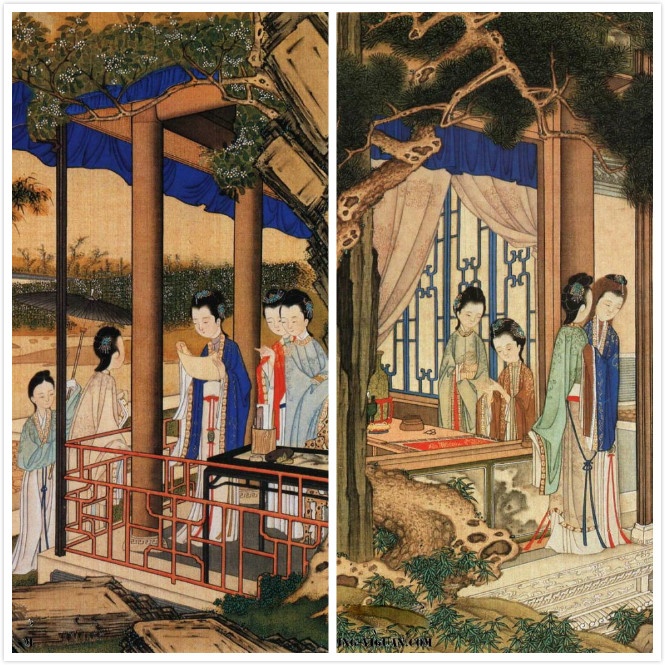
Fig.1: Jiao Bingzhen, Classic ladies, Album leaves, ink and color on silk, Beijing: National Palace Museum. For reproduction, see Painting of Qing court 清代宮廷繪畫, Beijing: the antiquity publisher (Wenwu Chubanshe), 1992, plate 1.For example, in Qiu Ying’s 仇英(c.1498-1552) Spring Morning in Han Palace汉宫春晓图(Fig.2), we could find the same attempt to display beauties’ lives in a luxury palace. However, unlike Jiao’s album, the court scene was depicted in an unfixed viewpoint and fragmented proportion, while the decorative qualities more reflected the style of Tang and Song periods, which made Spring Morning in Han Palace failed to achieve a unity between visual language and literal assumption compared with Jiao’s album. This contrasting use of perspective reflects the advancement of Jiao Bingzhen’s work.Fig.2: Qiu Ying, Spring Morning in Han Palace, section of a handscroll, ink and coloe on silk, Taibei: Palace Museum Collection.To distinct Jiao’s absorption of western technique and the traditional court painting style, another significant evidence could be found in Hu Jing’s Guochao Yuanhualu国朝院画录, in which the author indicated that Jiao Bingzhen’s “skillfulness in painting figures, landscapes, architectures is referred from the west methods. ”[7] Regarding Jiao’s landscape,the author further argued that through scientific examination of space, the painter shows an accuracy of measuring distance in the recession of mountains, which differs from simply “holding brushes” to paint. [8]However, if we make a close observation to this album, we would find that the approach to realism derived from western techniques is not fully applied. In other words, there seems to be a selected execution of techniques such as perspective, chiaroscuro, proportional examination, etc. According to Shan Guoqiang单国强, most Chinese painters in Qing court absorbed western methods in their own way and translated them into a new language.[9] This is also true in Jiao’s Album of Classic Ladies. Despite the perspective used to create a 3-dimensional illusion to the architecture and landscape settings, the perfect naturalism seems not to be equally applied to the individual figures, not only because they share the same appearance, but the distorted body proportion and assimilated faces carry a strong message of a lack of individuality and realism. Apart from the economical use of shading on women’s faces, there is seldom evidence showing foreign reference in the depiction of human figures. One may argue that Jiao’s mastery of western technique was still limited to portray a realistic human figure, since he was in an initial stage of combining western elements into court art in Kangxi’s reign. It could be partially true that Jiao’s skill remained elementary to depict the observatory nature of human. However, when it comes to the subject of Classic Ladies, there might be immanent cause from traditional Chinese culture which finally led to this unsatisfactory. Before further discussing this album, it would be necessary to briefly chase the origin of this subject matter.Painting of classic ladies has a long tradition in the development of Chinese history which could probably dates back to Gu Kaizhi 顾恺之(c.348-409) in the Six Dynasties.[10] However, it was not until Ming and Qing dynasties did this type of paintings reach a new systematic recognition which was categorized as meirenhua 美人画(painting of beautiful women).[11] With the development of urban citizen culture and rise of literatures about secret love or romance between beauties and scholars, there appeared an illustrated prints attached to some of the famous novels and dramas such as Dream of the Red Chamber红楼梦, Story of the West Chamber西厢记. The illustrations of the novels usually provide a visual narrative corresponding to the stories being told. Many illustrators have their own preference to depict the images of female figures with their inner qualities, usually setting them in beautiful gardens, elaborated architectures, magic landscapes and so on. One of the most famous illustrations was Gai Qi’s 改琦(1773-1828) prints to Dream of the Red Chamber (Fig.3). In this series of illustration, Gai Qi depicts The Twelve Beauties金陵十二钗 in Dream of the Red Chamber which later on developed a wider comprehension of both a group of beauties and a beautiful individual[12]. In Gai Qi’s version, there are not only the appearance of the beauties, but also emphasis on the settings and activities of each female in terms of their different characteristics. One thing remarkable of this illustration is that the painter seems to be very interested in the surrounding of these beautiful ladies as well as what kind of items they are equipped with. All these features contribute to concept of a feminine space which, according to Wu Hong巫鸿, is “a spatial entity——an artificial world composed of landscape, vegetation, architecture, atmosphere, climate, color fragrance, light, and sound as well as selected human occupants and their activity”, summing up “female qualities while providing a specific environment.”[13] The more this feminine space is depicted realistic and detailed, the more private the picture would seem to be when hung in a man’s room, supposedly the owner of the real space is eager to enter into some imaginary space. As Wu Hung notices, this type of privacy leads to the intimacy, through which the viewers (usually males) not only play a role as the patron of the painting, but also involve into some kind of imaginary events with women.[14] Among all the components associated to a feminine space, architectural settings are considered to be prominent and effective object since they provide the space with a dynamic/temporal structure and points of view.[15] It therefore explains the reason why many Ming-Qing novelist such as Cao Xueqin曹雪芹 (1715-1763), Wang Shipu王实甫 (1260-1336) prefer to site a feminine architecture (beautiful gardens, palace, pavilion, etc.) or legendary landscape (flying willow trees, flowing water, mirror lake, etc.) before moving to the real description of a certain beauty. 
 Fig.3: Gai Qi, Album of Illustration to Dream of the Red Chamber, prints.Another feature in the establishing of feminine spaces is that they are commonly depicted as highly isolated, which could also be observed in Jiao’s Album of Classical Ladies. Although there is no lack of open-air scenes in this Album, all the leisure activities seem to be taking place in a non-interrupted paradise. In other words, despite the realism applied to build convincing spaces, they are staged as a non-secular world. Anne Birrell puts this world as a secret love space, where all the daily servants, children, friends, family, and above all, husbands or man lovers remain absent. Keeping the women in chamber in a symbolically isolated state, the painter therefore put them in the luxury “prison”, leaving them in loneliness to meet the idealized expectations for love in the romance poetry in ancient China.[16] From the depiction of Chinese love poetry as well as meiren美人paintings to capture lives of classical ladies, “women in chamber” had become a stereotype indicating privacy, intimacy and isolation in the hierarchy of the state-family structure dominated by male readers and viewers in Ming and Qing Dynasties. As a matter of fact, from late Ming dynasty, domestic women were given much more freedom to travel in communities, so as their rights to engage in public intellectual activities through creative actions such as writing, painting and group discussion.[17] Furthermore, Dorothy Ko used to divide women in Ming and Qing society into three categories: domestic, socialized and public, all of which are able to enjoy different levels of public engagement. Above all, there is one type of woman besides those three who began to grow high reputation in the literati circle: the celebrated courtesan, or famous prostitute. They are the very group who actually started to make close relationship with intellectuals to both emotional and artistic extends, while remaining most weak and dependent to male in social structure towards women.[18] From this perspective, the real women in chamber are to be less consumed than the courtesans, providing a misleading chance in artistic creation that all women in Ming and Qing dynasties are privately occupied, intimately linking to love affairs and isolated from the social matters that they indeed participated. The meiren painting also originated from the legendary literati tradition in southern cities such as Hangzhou杭州, Suzhou苏州, “where a courtesan culture flourished and where they lived”.[19] When the concept of meiren or beauties came to the literati level, it eventually developed as a certain stereotype which was frequently implied in the lack of individuality in most meiren paintings. For example, a Qing literati named Xu Zhen徐震exemplified a standardized type of beautiful woman in his Manual of Beautiful Women, categorizing them into physical appearance, dressing styles, skills, activities, dwelling and so on.[20] Under this particular trend, the images of meiren became idealized with a negligence of individuality. Star-bright eyes, willow-leaf eyebrows, cloud-like hair, weak bodies that even cannot stand the wind, slim shapes with great fluidity and many other features became a formula in various meiren paintings while “literally conventions for describing beautiful women offer endless-repeated similarities”.[21]Now when we come back to Jiao Bingzhen’s classic ladies, it would not be confusing in his simplified depiction of the beauty images. All the body shapes, external appearance and activities of classic ladies strictly follow the stereotype which was set upon the literati expectation of a beautiful woman. Since they were considered as a group of idealized images, little need of representation of physical truth was actually required. Instead, the western handling to make a figure more approachable and realistic would only interrupt the ideal of classic ladies in Chinese visual language and taste. On the other hand, what Jiao Bingzhen had transcended from other meiren painters was his proper use of western linear method in the construction of a perfect feminine space. The realism applied on the architectural settings has successfully achieved a visual fulfillment of the whole atmosphere of meiren from the literal level. According to Wu Hung, Jiao Bingzhen had “reinterpreted the tradition representation of feminine space” by making space not only a symbolic sphere but a visual believability, which forms a perfect unity instead of simply the sum of individual features.[22] The idealized figures, together with the accurate background settings resembling the Land of illusion in Dream of the Red Chamber[23], achieve a perfect imagery scene according to the concept of meiren painting. In a word, by using western skills and simultaneously preserving Chinese essence, Jiao made a best combination of these two languages and concreted them as an advanced kind of meiren painting.Despite the literati origins, Album of Classic Ladies also embodies another iconography when this genre was taken by the Manchu imperial court. The different meanings of meiren painting in court and among the literati circulation made the same subject matter serve in very different purposes.Generally speaking, most of the meiren paintings in either court art or non-court art are fundamentally functioned as a visual consumption for males as the dominate sex. As James Cahill points out, in the best of the Qing dynasty meiren paintings, there is common feature of meeting the male viewers’ willingness to enter into the private feminine space where beautiful women carry out daily routines, while most of which are related to sex implications due to the privacy and intimacy in viewing. The paintings actually transformed an imaginary world into a visually “real world” where beautiful women act as accessible objects of sexual desire.[24]However, apart from the sensual qualities, there remains a hidden cultural implication among the literati in the South. According to Yang Dong and Xu Ze, there are mainly four expectations in describing beautiful women in Ming and Qing dynasty. They are “feelings”, “talents”, “disease” and “weakness”. [25] The first two features could be quite comprehensible, for that “feelings”, usually refer to love and romance, are basically a permanent theme in literature about women in literature, while “talents”, according to James Cahill, are usually an invisible assumption together with “feelings”.[26] However, “Disease” and “weakness” could be seen in a growing appreciation to pictorial women who have a fragile bodies, weensy waists, melancholy expressions and dizzy faces, leading to the flourishing of morbid beauty. There is a common recognition in the studies that the fragility of female bodies in traditional Chinese painting are to suggest male’s privileges and domination on the opposite sex.[27] Still, this distorted aesthetic perception might lead to another interpretation when political coercion became reinforced during Ming and Qing, and the voices of the literati class became more and more marginalized.[28] A large group of unrecognized intellectuals, especially those from the South eventually began to explore a new way to express their depression through painting of beautiful women who look extremely weak. For instance, a Qing literati namely Shi Zhengli史震林 used to write a sentence in his book to indicate the similar circumstance of unemployed scholars and untended beauties:“There are two situations worthy crying one’s heart out. One is good works not being appreciated by others. The other is forlorn beauties not being recognized.”[29]Fig. 4: Tang Yin, Beauty with a Silk Fan Standing in the Autumnal Wind, ink on paper, Museum of Shanghai.An earlier example showing the tendency of using grieved beautiful woman as a metaphor of unappreciated scholars is Tang Yin’s唐寅 (c.1470-1523) Beauty with a Silk Fan Standing in Autumnal Wind秋风纨扇图(fig. 4), through which he expresses his agonizing heart by painting a sorrowful lady standing lonely in an abstract landscape. The inscribed poem on the left corner further explains the metaphorical comparison of this lady to an unfortunate scholar:When the autumn comes, a silk fan is to be taken out from the collection,Beauty, what makes you in such sorrowful mood?Please, make a close look to the world,Who is not careless about the desolated ones and escaping from them?[30]
As a matter of fact, the relation between the literati’s obsession with feelings for beautiful women and his career setbacks could be traced back to earlier dynasties and became a legacy in Qing dynasty. [31] According to Feng Menglong冯梦龙(1574-1646)who wrote A History of Love情史,Qing情(feelings to women) is a symbol of a type of educated sentiment embodied in a person with rich emotion, which, according to the writer, should be treasured and preserved. [32] On the one hand, this tendency flourished as “good stories”佳话 among the literati circulation, on the other hand, it could be reflexively understood as the situations of scholars as Tang Yin, who were not appreciated by the court authority under the hierarchy of Confucianism ideology, finding them another path to mark their reputation in art with the empathy to depict a weak beauty. Fig.5: Gai Qi, Four Beauties, ink and color on silk, Museum of Ningxia.Until Qing dynasty, the famous painter Gai Qi, Fei Danxu费丹旭 (1801-1850), Yu Ji余集 (1738-1823) might have pushed this trend to extremes. The Four Beauties (fig.5), painted by Gai Qi, shows four extremely slim ladies standing in separated frames, each part with an inscription poem, adding mood to the painting. Although they are recognized as beautiful women in the conceptual system, none of them look joyful. Being extremely weak and fragile, their eyes are starring at the land as if seeing through the emptiness of life. Are they simply being sentimental about love? Or are these complicated feelings reflecting a scholar who failed at his career? According to Yang Dong’s interpretation, by shaping beauties into morbid images, both physically and mentally, the marginalized scholars are searching for a certain type of psychological balance between the political failure and their gender priority.[33]
As one can imagine, this tendency on iconography would not be tolerated in court art now dominated by the Manchu. Having abandoned the literati implication, Album of classic ladies only preserves the decorative and erotic quality of meiren painting. As a matter of fact, the existence of meiren painting in Qing court has already been an unexpected phenomenon. In order to control the intellectuals’ minds and maintain Manchu’s authority, Qing rulers have set up strict regulations for the contents of court painters’ work.[34] According to the introduction of Qing court art in Beijing Palace Museum, there are mainly four types of painting which were allowed to be executed in court art: painting of record, painting of history, painting for decoration and painting for religion.[35] Under this circumstance, Jiao Bingzhen’s album was actually a particular case with a group of women dressing in traditional Chinese costumes. It has huge possibility to be an imaginary scene since Emperor Kangxi had established a restriction that no court lady was allowed to dress in Chinese costume and any woman who dressed in Chinese costume was forbidden to enter the court.[36] Ironically, the painting of Chinese classic ladies were actually patronized by the emperor and this genre was later repeated over times by court artists like Ding Guanpeng丁观鹏, Jin Tingbiao金廷标, which indicates the emperors’ permission of something that were formally banned by themselves. The reasons for this strange phenomenon might be analyzed in two aspects.Firstly, according to Wu Hung’s proposition, the meiren painting in court art also plays as a private appreciation to meet the emperors’ interests in the “Chinese-ness” and exoticism of beautiful women outside their world.[37] In other words, by exposing the secret scene of beautiful women in various activities, dressing in Chinese costumes, surrounded by dream-like landscape which marks a traditional scenery of the south, the paintings reach a certain level of entertainment in the consumption of fantasy and exoticism. A best example could be emperor Yongzheng’s Collection of Twelve Beauties十二美人图(Fig. 6)which used to be placed in his living room before his engagement of throne. And after his succession of the reign, the twelve leaves were secretly hidden to avoid disputation. From the album of ladies dressed in traditional han costumes, we could find that the color is strongly elaborated, the images are meticulously embellished, and the settings are strictly examined, all of which suggest a departure from a literati meiren painting and the integration with other decorative court arts such as bird-flower paintings, animal paintings and landscape paintings. The only difference of this type of painting from decorative art is that they indicate a secret physical pleasure probably associated with love, romance and sex. If we compare Album of Classic Ladies with formal portrait of court women, the function it serves might be even clearer. Portrait of loyal concubine Huixian (fig.7) is a formal portrait showing what a Manchu woman was supposed to be. Although the figure was depicted in highly individuality and dressed in delicate Manchu costumes and adornments, it is of few qualities about enjoyment of female beauty but a demonstration of Manchu’s authority. While the Album of Clascsic Ladies, on the other hand, provides a good quality of leisure entertainment. Fig.6: Anonymous, “The Twelve Beauties”, (selected pieces) Yongzheng period, Beijing: Palace Museum.Fig.7: Anonymous, Portrait of Huixian, oil on paper, Beijing: National Palace MuseumSecondly, the album may also have a political implication. According to Wu Hung, this approach is described as a Manchu’s political action to insure the heritage of Chinese culture and art. [38] As is mentioned before, Album of Classic Ladies signifies various cultural marks of Chinese tradition, particular the culture of southern China, which could be associated to Manchu’s political prestige to the South. Historical records show that both Kangxi and Qianlong were quite concerned about the development of the south and they both paid several visits to southern China.[39] Cities like Hangzhou, Suzhou in Manchu’s mind not only site a fantasy land but also symbolize special districts with high economic prosperity and cultural superiority where the rulers should pay special attention. Kangxi was even made his Southern tours a set of formal paintings as a visual record of this grand event in Wang Hui王翚(1632-1717)’s Emperor Kangxi Visiting the South康熙南巡图(fig.8). Apart from the recorded southern scenes for documentary use, there are also artworks showing the imaginary south. The screen with oil painting in the front entitled Ladies under Wutong Tree梧桐树下仕女(fig.9) could be a typical example. In this oil painting, the beautiful ladies again dressed in traditional Chinese costumes seem to be inviting the viewers looking through the pavilion gate to the wide landscape, which symbolizes an imaginary southern China. Jiao Bingzhen’s classic ladies, by setting them in a very predominated southern atmosphere, might have large potential to share the similarity to Ladies under Wutong Trees, in which Emperor Kangxi used to set up “a symbolic connection between the central court and southern China.”[40]
 Fig 8: Wang Hui, Emperor Kangxi’s southern tour(datail), color on silk, Beijing: National Palace Museum.Fig 9: Anonymous, “Painted Screen”, Kangxi period, Beijing: National Palace Museum, front: “Ladies under Wutong Trees”, oil painting on canvas.To summarize all the analysis above, Jiao Bingzhen’s Album of Classic Ladies was a set of court art reflecting different cultures and tastes in a particular period of China. With the absorbing of western technique and reference from Chinese urban culture as well as literati tradition, Album of Classic Ladies ultimately contributed in the establishment of Qing pictorial language which was dominate by Manchu pursuit in both political and artistic fields. Therefore, it is a significant crossing-cultural artwork in late imperial China.
[1] Regarding Jiao Bingzhen’s activities in Kangxi’s court as well as his prominence, see Daphne Lange Rosenzweig, “Court Paniters of Kangxi’s Period”, Phd diss. (Columbia University, 1973), 149-167.[2]Michael Sullivan, “the Chinese Response to Western Art”, Art International 24, nos.3-4 (November-December 1980) ,14.[3] Hiromitsu Kobayashi, “Suzhou Prints and Western Perspective: The Painting Techniques of Jesuit Artists at the Qing Court, and Dissemination of the Contemporary Court Style of Painting to Mid-18th Century Chinese Society through Woodblock Prints”, in John W.O Malley ed., The JesuitsⅡ: Cultures, Science, and the Arts 1540-1773 (Toronto: University of Toronto Press, 2006), 263.[5] Zheng Geng张庚, Guochao Huashi lu II国朝画征录(卷2), 31-32, referred from Michael Sullivan, 14.[6]Wu Hung, “Beyond Stereotypes: The Twelve Beauties in Qing Court Art and the ‘Dream of the Red Chamber’”, in Writing Women in the Late Imperial China, ed. Ellen Widmer and Kang-I Sun Chang (California: Stanford University Press, 1997), 335.[7] “工人物山水楼观,参用海西法”. Hu Jing胡进, Guochao Yuanhualu 国朝院画录,see Hushi Shuhuakao Sanzhong 胡氏书画考三种,Vol.1.[8]“素按七政之躔度五形之远近,所以危峰叠嶂中,分咫尺之万里,岂止于手握双笔,故书而记之。”Hu Jing, Guochao Yuanhualu 国朝院画录,see Hushi Shuhuakao Sanzhong 胡氏书画考三种,Vol.1.[9]Shan Guoqiang, “the Features of Women Painting in Qing Court”, Forbidden City (No.3, 1995), 17.[10] Huang Jun, the Study and Techniques on Women Paintings仕女画的研究与技法 (Beijing: Beijing Art&Craft publishing house, 1987), 2.[11] Writing Women in the Late Imperial China, 323.[12] Writing Women in the Late Imperial China,309.[14] Wu Hung, The Double Screen: Medium and Representation in Chinese Painting, translated by Wen Dan (Shanghai: Shanghai People’s Publishing House, 2017), 204-205.[15] Writing Women in the Late Imperial China, 325.[16] Anne Birrell, New Songs from a Jade Terrace (London,1982), 11-12.[17] Dorothy Ko, Teachers of the Inner Chamber: Women and Culture in Seventeenth-century China, translated by Li Zhisheng (Nanjing: Jiangsu People’s Publishing House, 2004), 13-15.[19] Writing Women in the Late Imperial China, 330.[20] Xu Zhen is a southern literati scholar active during the end of Ming and early Qing. In Manual of Beauties, he demonstrated rigidized the features of a beauty into categories, which was later compiled into Chong Tianzi (Qing),Xiangyan Congshu香艳丛书 (Beijing: Renmin Wenxue Chubanshe, 1992), vol.1, 11-13.[21]James Cahill, “the Flower and Mirror: Images of Women in Late Chinese Painting”, in the Writing of James Cahill: Women in Chinese painting, http://jamescahill.info/r11.240.146.shtml,access,24th Nov. 2016.[22] Writing Women in the Late Imperial China, 335.[23] In Dream of the Red Chamber, Cao Xueqin spent a whole chapter focusing on a land of illusion where Jia Baoyu, followed by Lady Jinghuan, met the twelve beauties in a dream-like atmosphere. See Cao Xueqin and Gao E, A Dream in Red Mansions, translated by Yang Xianyi and Gladys Yang (Hunan: foreign language press, 1999), chapter 5.[24]James Cahill, “the Flower and Mirror: Images of Women in Late Chinese Painting”, in the Writing of James Cahill: Women in Chinese painting, http://jamescahill.info/r11.240.146.shtml,access,24th Nov. 2016.[25]Yang Dong, Xu Ze, “the Sweetheart in Scholar Ideal and the Scholar Painting of Beautiful Women in the Ming and Qing Dynasties”, Journal of Taizhou University, Vol.27, No.2 (April 2005), 18.[26]James Cahill, “the Flower and Mirror: Images of Women in Late Chinese Painting”, in the Writing of James Cahill: Women in Chinese painting, http://jamescahill.info/r11.240.146.shtml,access,24th Nov. 2016.[27] A detailed discussion of this iconography could be seen in Mary H. Fong, Images of Women in Traditional Chinese Painting, Woman’s Art Journal, Vol.17, No.1 (Spring-Summer, 1996), 24.[28] Yang Dong, Xu Ze, 18.[29] Shi Zhenlin, Desultory Notes of Xiqing西青散记, quoted from Yang Dong, Xu Ze, 19.[30] “秋来纨扇合收藏, 何事佳人重感伤。请托世情详细看,大都谁不逐炎凉” (A literal translation of the poem).[31] The feelings (Qing 情), started in the Pre-Qin literature as a basic human nature is highly treasured in the circle of traditional confucian scholars throughout Chinese culture, while it became particularly prominent in courtesan literature during Ming and Qing dynasties. Further discussion could be seen in Martin W. Huang, “Sentiments of Desire: Thoughts on the Cult of Qing in Ming-Qing Literature”, Chinese Literature: Essays, Articles, Reviews, Vol. 20 (Dec. 1998), 153-161.[32] “Qingshi Xu”情史序 (written under the name of Long Ziyou 龙子犹), Qingshi情史, 1a-2a, Feng Menglong quanji冯梦龙全集 (Shanghai: Shanghai guji, 1993), vol. 37, 1-3.[33]Yang Dong, “The Sentimental Feature of Paintings of Beautiful Woman in the Ming and Qing Dynasties”, Journal of Dezhou University, Vol. 21, No.1 (February, 2005), 101.[34]Palace museum in Beijing, Painting of Qing court 清代宫廷绘画 (Beijing: Cultural Relics Publishing House, 1992), 26.[37] Writing Women in the Late Imperial China, 354.[39] About Kangxi’s six tours to Jiangnan (the South) and Qianlong’s tours to Jiangnan, see Frederick. W. Mote, Imperial China 900-1800 (Cambridge Mass: Harvard University Press, 1999), 867-868, 916.[40] Writing Women in the Late Imperial China, 355.1. Birrell, Anne, New Songs from a Jade Terrace (London, 1982).2. Cahill, James, “the Flower and Mirrior: Images of Women in Late Chinese Painting”, in the Writing of James Cahill: Women in Chinese Painting, http://jamescahill.info/r11.240.146.shtml,access,24th Nov. 2016.3. Cao, Xueqin and Gao, E,A Dream in Red Mansions, translated by Yang Xianyi and Gladys Yang (Hunan: foreign language press, 1999).4. Chen, Haoxing, The Golden Exile: Survey of the Western Missionaries' Painting School of the Qing Dynasty Court (Macow: Macow Art Museum, 2002).5. Fong, Mary H., Images of Women in Traditional Chinese Painting, Woman’s Art Journal, Vol.17, No.1 (Spring-Summer, 1996): pp.22-27.6. Huang, Jun, the Study and Techniques on Women Paintings仕女画的研究与技法 (Beijing: Beijing Art&Craft Publishing House, 1987).7. Hu Jing,Guochao Yuanhualu国朝院画录,see Hushi Shuhuakao Sanzhong胡氏书画考三种8. Huang, Martin W., Sentiments of Desire: Thoughts on the Cult of Qing in Ming-Qing Literature, Chinese Literature: Essays, Articles, Reviews, Vol. 20 (Dec. 1998): 153-184. 9. Ko, Dorothy, Teachers of the Inner Chamber: Women and Culture in Seventeenth-century China (Stanford, 1994).10. -------, Teachers of the Inner Chamber: Women and Culture in Seventeenth-century China, translated by Li Zhisheng (Nanjing: Jiangsu People’s Publishing House, 2004).11. Li, Ti, ed., Select Woman Paintings through the Ages in the Collection of the Palace Museum in Beijin故宫藏历代仕女画选集(Beijing: Forbidden City Publisher, 2002).12. Malley, John W.O, ed., The Jesuits II: Cultures, Science, and the Arts 1540-1773 (Toronto: University of Toronto Press, 2006).13. Mote, Frederick. W. Imperial China 900-1800 (Cambridge Mass: Harvard University Press, 1999).14. Palace Museum in Beijing, Painting of Qing Court 清代宫廷绘画(Beijing: Cultural Relics Publishing House, 1992).15. “Qingshi Xu”情史序 (written under the name of Long Ziyou 龙子犹), Qingshi情史, 1a-2a, Feng Menglong Quanji冯梦龙全集 (Shanghai: Shanghai guji, 1993), vol. 37. 16. Rosenzweig, Daphne Lange “Court Paniters of Kangxi’s Period”, Ph.d diss. (Columbia University, 1973). 17. Shan, Guoqiang, “the Features of Women Painting in Qing Court”, Forbidden City No.3, 1995: 31-45.18. Sullivan, Michael, “The Chinese Response to Western Art”, Art International 24, nos.3-4 (November-December 1980).19. Tianzi, Chong (Qing), Xiangyan Congshu香艳丛书 (Beijing: Renmin Wenxue Chubanshe, 1992).20. Widmer, Ellen and Chang, Kang-I Sun ed., Writing Women in the Late Imperial China (California: Stanford University Press, 1997).21. Wu Hung, The Double Screen: Medium and Representation in Chinese Painting, translated by Wen Dan (Shanghai: Shanghai People’s Publishing House, 2017).22. Yang,Dong, “The Sentimental Feature of Paintings of Beautiful Woman in the Ming and Qing Dynasties”, Journal of Dezhou University, Vol. 21, No.1 (February, 2005): 100-102.23. Yang,Dong,and Xu, Ze, “the Sweetheart in Scholar Ideal and the Scholar Painting of Beautiful Women in the Ming and Qing Dynasties”, Journal of Taizhou University, Vol.27, No.2 (April 2005): 17-19,27.
作者简介:金影村,浙江大学美学与批评理论研究所博士,青年艺术评论人。主要研究领域为中西方美术史、美学、现当代艺术理论。2009年本科毕业于香港大学文学院,获文学士学位。2010-2013年获北京大学、英国约克大学硕士双学位。2016年出版译著《分殊正典——女性主义欲望与艺术史书写》。论文曾发表于《美术》、《外国美学》、《艺术设计研究》、《当代美术家》、《北方美术》等多家重点期刊,同时致力于策展、艺术评论、艺术翻译等工作。现任教于浙江理工大学服装学院。



 {{newsData.good_count}}

 {{newsData.transfer_count}}




 分享
分享