
GBA Keywords | Canton Fair

In 1957, the Canton Fair (now the China Import and Export Fair) opened at the Sino-Soviet Friendship Hall in Guangzhou. It is still held every spring and fall, though the fair has moved four times since then. Prior to the Canton Fair, the first trade fair in Guangzhou was the South China Local Products Expo in 1951. A new socialist exposition hall was built alongside the Thirteen Factories—a historical enclave for foreign trade during Qing Empire—and the venue has host several more trade expos in 1955 and 1956. During the early years of Reform and Opening, the Shekou Industrial Zone, established by Hong Kong's China Merchants Group, would attempt to perform a similar function to the Canton Fair, but in a different way. The Chinese General Chamber of Commerce and a range of businesses in Hong Kong have long been key participants in the trade fairs held in Guangzhou. Even after the Canton Fair was established, it relied on previous organizations: the Chinese General Chamber of Commerce continued to send out the invitations to Hong Kong businesses on behalf of the Canton Fair 1.
With the deterritorialization of the neo-liberal economy, the importance of the Canton Fair in trade has declined over the last 15 years 2. However, with the recent discussions of the Greater Bay Area and One Belt, One Road, the Canton Fair has become a more important part of the official history. Prior to Reform and Opening, the Canton Fair was irreplaceable infrastructure for the Chinese socialist market economy, designed to circumvent Cold War trade blockades. At the time, these fairs required a host of related services – taxicabs, food service at foreign-oriented hotels, international communication and banking facilities, and contract default management—most of which did not exist in the rest of society and therefore relied on practical policymaking. Without access to archives, Zhou Enlai's speeches related to the Canton Fair serve as our only reference for this policy flexibility. For Guangzhou residents, the Canton Fair created cultural memories of "foreign-oriented" (shewai) things: the fair site, the Guangzhou train station, foreign-oriented hotels, taxicabs, foreign-oriented services, translators, and gardens that blended Chinese and Western styles. French anthropologist Marc Augé described hotels, train stations, and shopping malls as "non-places," because of how people experienced those spaces, but in socialist-era Guangzhou, this trade infrastructure left city residents with a kind of cultural memory and shaped the city's landscape and the nature of residents' memories. If these kinds of spaces were "non-places," they were not glossy, abstract functional spaces; instead, they allowed for the free imagination of other places. This idea is best reflected in the socialist architectural style of these buildings, which echoes the architecture projects that socialist China helped to build in Asia, Africa, and Latin America 3.
1 Zhongguo Duiwai Maoyi Zhongxin (China Foreign Trade Center), Qinli Guangjiaohui (Personal Experiences of the Canton Fair), Guangzhou: Nanfang Ribao (Southern Daily), 2006, 224-226.
2 Lin Yi, Guangjiaohui: Duiwai kaifang de jiluzhe (The Canton Fair: A Record of Opening to the World), Zhongguo Zhengxie Zazhi (The CPPCC Magazine), January 16, 2019.
3 Ke Song. Modernism in Late-Mao China: A Critical Analysis on State-Sponsored Buildings in Beijing, Guangzhou, and Overseas, 1969-1976. Ph.D. diss, Melbourne School of Design, 2017.
Guangzhou Architectural Fact Collection (Guangzhou Jianzhu Shilu), Guangzhou Design Institute (Guangzhou Shejiyuan),1976
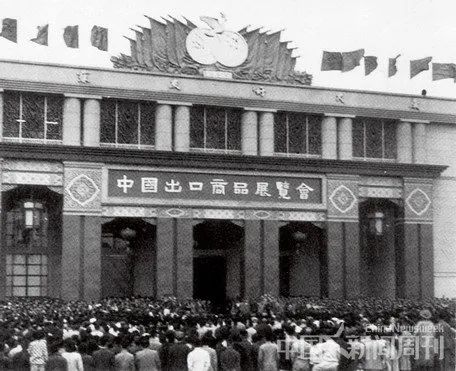
Sino-Soviet Friendship Hall, Guangzhou, 1957. It was the holding location of the first Canton Fair.
Source:CNSPHOTO
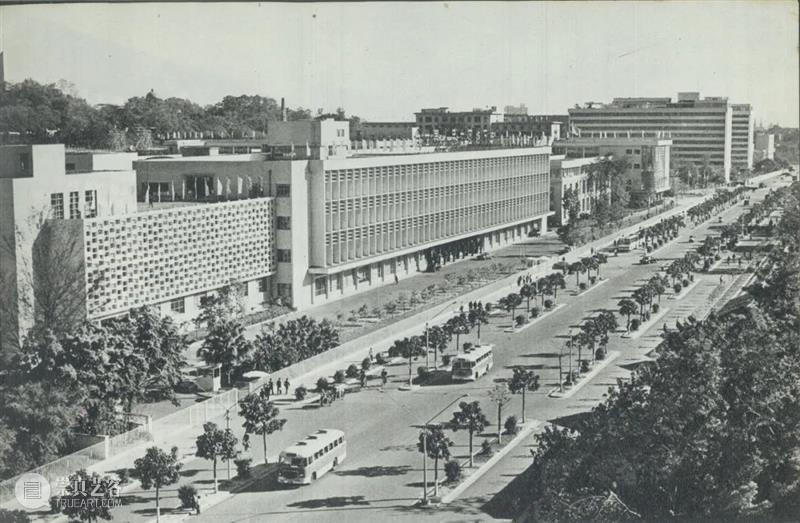
China Export Commodities Fair Liuhua Road Pavilion was built and opened in 1974
Source:
Guangzhou Architectural Fact Collection (Guangzhou Jianzhu Shilu), Guangzhou Design Institute (Guangzhou Shejiyuan),1976


Zian Chen is one of the editors for Heichi Magazine and Arrow Factory: The Last Five Years (2020), Olympic Reveries (2021). Currently, he is also working as online editor-in-residence at COMPOST for ICA Shanghai (2021-22). His ongoing serial writing, Instant Retrospectives, appeared in Heichi Magazine and LEAP.
The Canton Fair, or the China Import and Export Fair, is also known in its brief form as guangjiaohui(广交会)in Chinese.
Long before the Canton Fair, Guangzhou (formerly known as Canton) already had a long history of foreign trade. In what Westerners called the Canton System, trade between Chinese and foreign merchants was conducted in the Thirteen Firms in Guangzhou. Even after it no longer enjoyed the status of China's only port for foreign trade, Guangzhou was still an important port city for the nation and continued to play a role in China's foreign trade and international exchange. After the establishment of the People's Republic, China was confronted with economic blockades and goods embargoes imposed by Western countries, and the birth of the Canton Fair was destined. An international trade fair has been held in Guangzhou in spring and fall every year uninterruptedly since 1957, not even the Covid-19 pandemic could impose a pause.
The Canton Fair started as the trade show for Chinese exports, intended to promote Chinese products to the rest of the world. Asian businesspeople, including some overseas Chinese, made up the majority of attendees. The fair later developed to include product imports, becoming an import-export event. As a result, the Canton Fair was officially rebranded as the China Import and Export Fair. According to statistics from the organizer, 1,223 international buyers from 19 countries and regions attended when the Canton Fair first opened in spring 1957; by autumn 2019, these numbers had grown to 186,015 and 214 1.
Despite the official brand, "Canton Fair" remains widely used. Streams of people and goods passing through the Baiyun Airport during the biannual trade fair seasons, and cargo vessels and shipping containers coming in and out of the Huangpu Port and Guangzhou Port, both demonstrate the continuing legend of the city's foreign trade. The Pearl River Delta as "the World Factory" continues to support its center city Guangzhou with its concentrated and relatively inexpensive labor, efficient productivity, and robust transportation networks, maintaining its significance in foreign trade. If Guangzhou is the center of the World Factory, the Canton Fair is the central node of this trading network.
With the shift from the Pearl River Delta to the Greater Bay Area, up-to-date technological innovations are being introduced, next generation infrastructure is being constructed, and novel financial networks and logistics routes are being arranged. All of these may offer the Canton Fair more possibilities, or they may bring forth an impact from a multi-center paradigm. In spring 2020, the 127th Canton Fair was held online for the first time due to the pandemic. The fall 2020 one was also held online. Will this become the new normal? We are all witnesses to the Canton Fair's journey, eager to find out whether it can continue its tradition in foreign trade and cultural exchange, and whether it can promote China's smart manufacturing to the rest of the world, particularly in the time when technology develops and information circulates at thunderous speed.
1 Buyer Attendance of Previous Sessions, China Import and Export Fair, accessed June 27, 2021, http://www.cantonfair.org.cn/html/cantonfair/cn/about/2012-09/125.shtml.

Linessa Dan Lin is assistant professor of anthropology at Renmin University of China. She holds a PhD in anthropology from the Chinese University of Hong Kong. Her current work centres on critical analysis of ethnic and racial encounters of African traders' everyday lived experience in a (de)globalising China.


The "Guangdong-Hong Kong-Macao Greater Bay Area" is a new construction envisioned from a top-down perspective and territorial integration. It is a blueprint for a future urban development based on efficiency, speed, and mobility. What if we conceive the Greater Bay Area as an experiment, an imaginary experiment? On the one hand, there is the question of diversity. When we talk about smart cities, artificial intelligence, automation, ecological crisis, information security, the future of virtual reality, global trade, etc., where does this view of the future come from, and what determines it? On the other hand, a profound political, spatial, historical, and geographical significance is present in the Greater Bay Area. Is it possible to develop a different imagination based on the history and culture of the "Pearl River Delta-Greater Bay Area," meaning to consider a development departing from local knowledge production, negotiating with accelerating technologies, facilitating collaborations between art and other disciplines, and reshaping e the vision of institutions of art and technology? By exploring the diversity of technologies, human and non-human ecologies, and reproduction of social relations, might it be possible to reposition the "Greater Bay Area" as a pioneering experiment of southern China's technological and cultural imagination beyond a mere economic zone?

The Greater Bay Area Keywords Project is an ever-expanding think tank. We have collected 31 keywords from scholars around the world to launch the first round of thought processes. The project is continuously open to submissions worldwide, and we look forward to writers engaging in critical imaginations on culture, geopolitics, and technology around these questions, as mentioned above. Each keyword is illustrated in 300 words in English (500 words in Chinese). Please get in touch with us via email before you submit your manuscript. Once your manuscript is accepted, it will be published in English and Chinese on the Media Lab’s official website. Please find us at medialab@timesmuseum.org
推荐阅读

 {{newsData.good_count}}

 {{newsData.transfer_count}}


 {{item.good_count}}k
已展示全部
{{item.publisher_name}} 发布了 文章
{{item.title}}
更多功能等你开启...


 分享
分享