
Approach | Digitally Celestial


《切入 | Approach》 begins with a simple observation: the speculative core of contemporary media art can no longer be exhausted by a single art-historical perspective. When philosophy of technology, media theory, cultural studies, and artistic practice converge within the same field, we need a more penetrating mode of speech—not annotations on works, but dynamic deductions unfolded through the works themselves, reaching the essence through phenomena and attempting to glimpse the future development of media art. The third issue of Approach takes Liu Jiayu's solo exhibition "Still, Life / 双曜" as its anchor, featuring commentary by several scholars from different disciplinary backgrounds, each entering this speculation on computation, nature, and perception from their own path.
The first review in this series is written by curator Zhang Ga, originally published in English in Liu Jiayu's catalogue Signs of Light. Under the title "Digitally Celestial," Zhang Ga situates Liu Jiayu's practice within the coordinate system of generational shifts in Chinese media art. Using the three movements he delineated in the exhibition Motion is Action: 35 Years of Chinese Media Art — Motion as Action, Motion as Interaction, and Motion as Agency — as a historical framework, he outlines the trajectory of Chinese media art from 1988 to 2023, and thereby points out that Liu Jiayu belongs to the digitally native Generation Y, whose practices are animated by agency, inspired by cosmic awareness, and oriented toward a planetary outlook. In Zhang Ga's account, Liu Jiayu's art moves between the digital and the celestial, unfolding at a more-than-human scale, allowing nature to regain agency through motion, action, and interaction. So, when "motion" moves from action and interaction toward agency, and when nature regains speech through computation, what kind of planetary vision does Liu Jiayu's "Digitally Celestial" open up for us?
Digitally Celestial
Each generation bears its own phenotypic imprint. If Chinese media art has undergone the evolutionary shifts from motion as action, to motion as interaction, and onwards to motion as agency — motion being what defines media art, at its core, as an articulation of time and movement, as I have delineated in the exhibition Motion is Action: 35 Years of Chinese Media Art [1] — then Liu Jiayu emerges from a born-digital generation of artists whose practices are animated by an agentic sensibility, inspired by cosmic awareness, and oriented towards a planetary outlook.
That is the Generation Y.
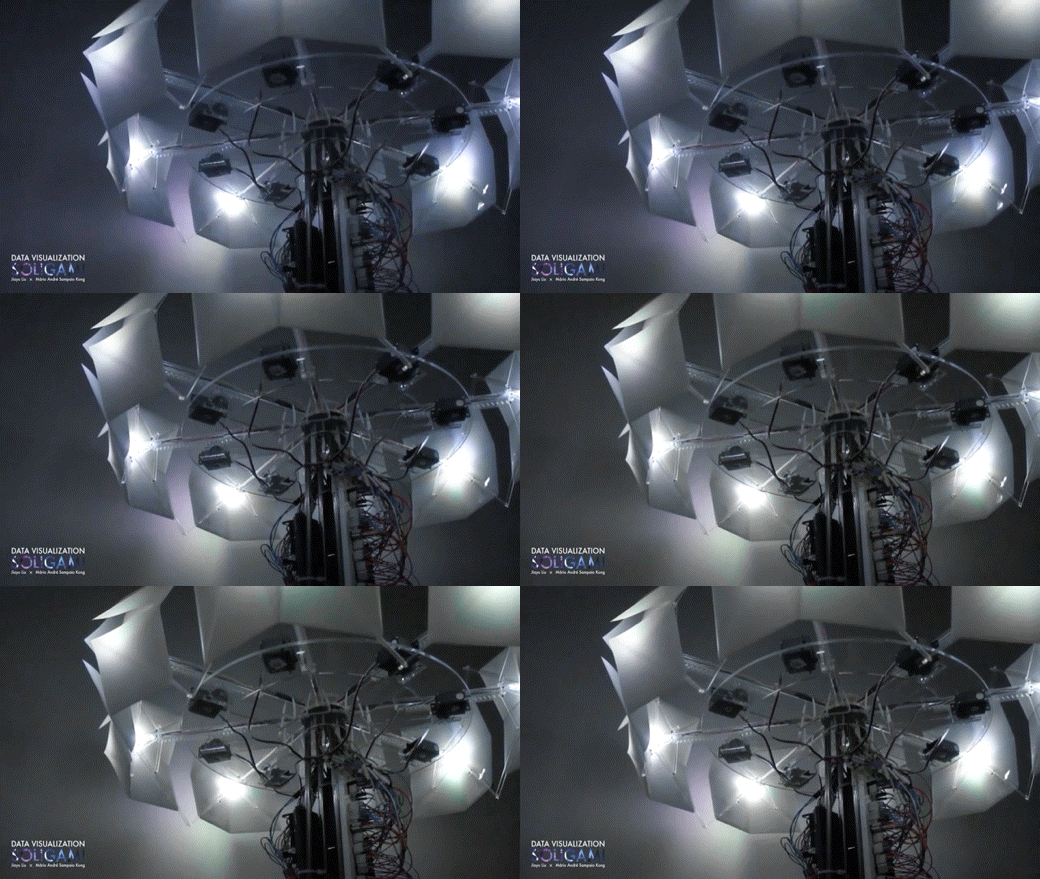
Liu Jiayu, Soligami, 2013. ?Liu Jiayu Studio
In the 2015 exhibition The Ballad of Generation Y [2] in which she was included, her work Soligami — a robotic origami whose kinetic behavior was governed by solar energy data — was already an inkling of a futurity she has since embarked on with great rigor and enchantment: life-data as intuition, agency propelled by nature, modest in scale but strong in signal, would become her fundamental modus operandi. Ten years on, she has orchestrated her little ballad of Generation Y into a symphonic grandeur that resounds with a renewed imagination of skies, mountains and rivers, and has landed us in a place in which rumination on the reconciliation of technology and natural process becomes an integral part of appreciating her mesmerizing work and poetic vision.
The Side Valley (2018) marks a turning point in her venture into a more-than-human scale of encounter with a temporality beyond the mechanical device of industrial time. In the gallery, we encounter a luminous winding shape projected from the ceiling, its flowing water reflecting the sky above the Vallée de Joux in Switzerland. Clouds drift, light shifts. What one experiences is a skyscape prepared by a machine-learning system trained on the sky’s diurnal rhythms, then set in motion by live wind data — its time unfolding beyond the abstraction of the clock. For that meditative artificiality to achieve an aura of nature, the artist and her team captured 6,400 images of the sky from all directions at fifteen-minute intervals over a period of thirty-two days to construct datasets for training an AI system, from which an artificial sky-world gradually emerged. The work thus explores a technical form of nonlinearity: a meteorological time recuperated by machine vision.
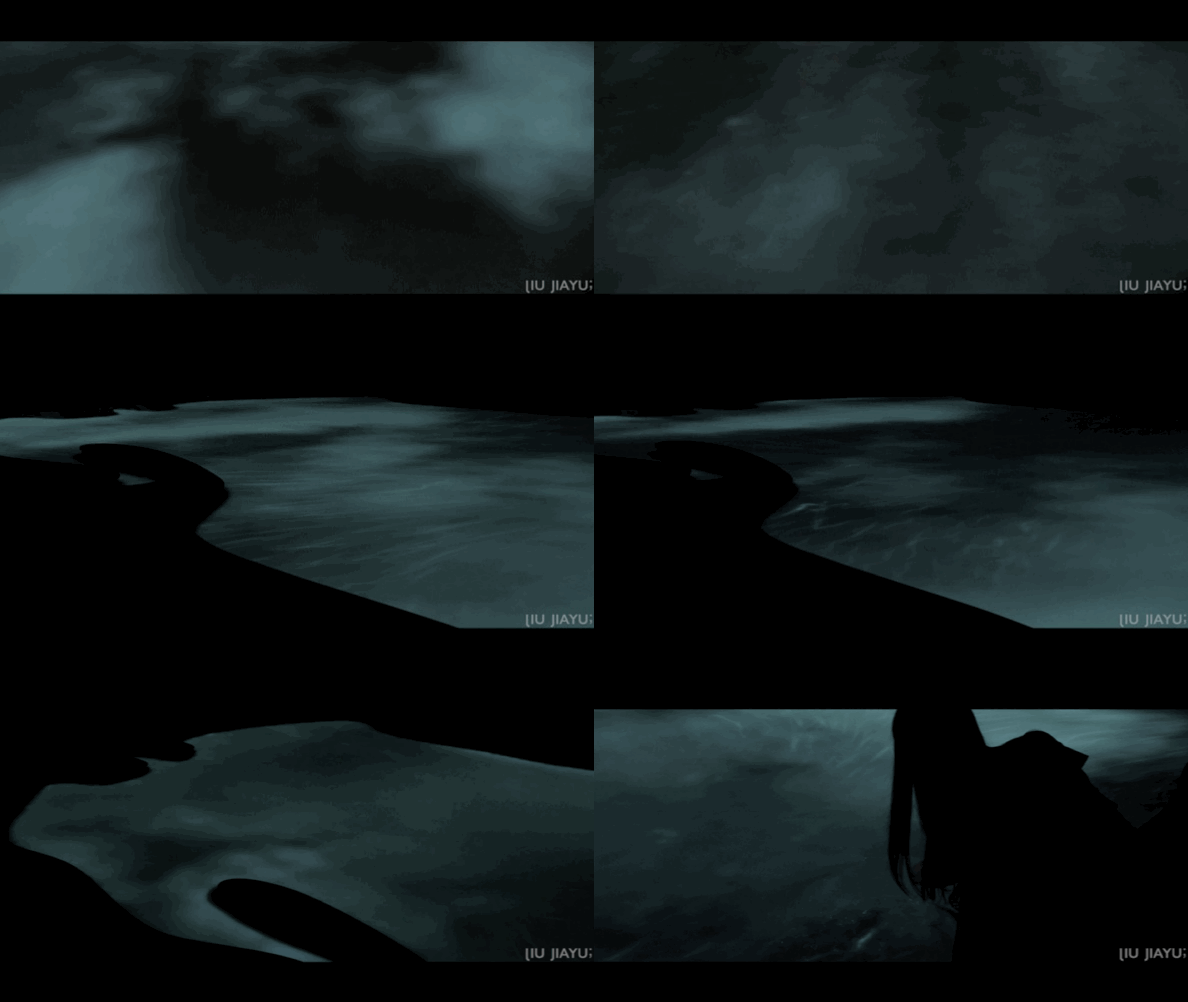
Liu Jiayu, The Side Valley, 2018. ?Liu Jiayu Studio
With In The Flow (2020), Liu Jiayu endeavored to achieve the extraordinary: monumentality takes its fresh incarnation in algorithms through mountain hills, fluid and solid at once. Virtual water of the geological eon running down the rocky cliff of the present day is the past returning anew and Earth’s deep time resurrected via technological maieutics. Projected onto an open area of 750 square meters on a karst stone peak, as if light beams were sculpting a life scroll painting, is flowing imagery composed of Earth's memory of tectonic transmutation, continental refiguration, and climatic fluctuation sedimented over hundreds of millions of years — excavated ocean pushing upwards, reenacting a history immemorial. Such an expansive gesture is as conceptually grand as it is logistically challenging. Liu Jiayu and her collaborators, using drones, made 3D scans of the entire mountain and then built a digital model, which was integrated into a simulated deep sea so that ancient waters may course over the contemporary mountaintop. The grandeur of this immense precision-mapped projection is a feat that relives the entanglement of natural memory and human history.
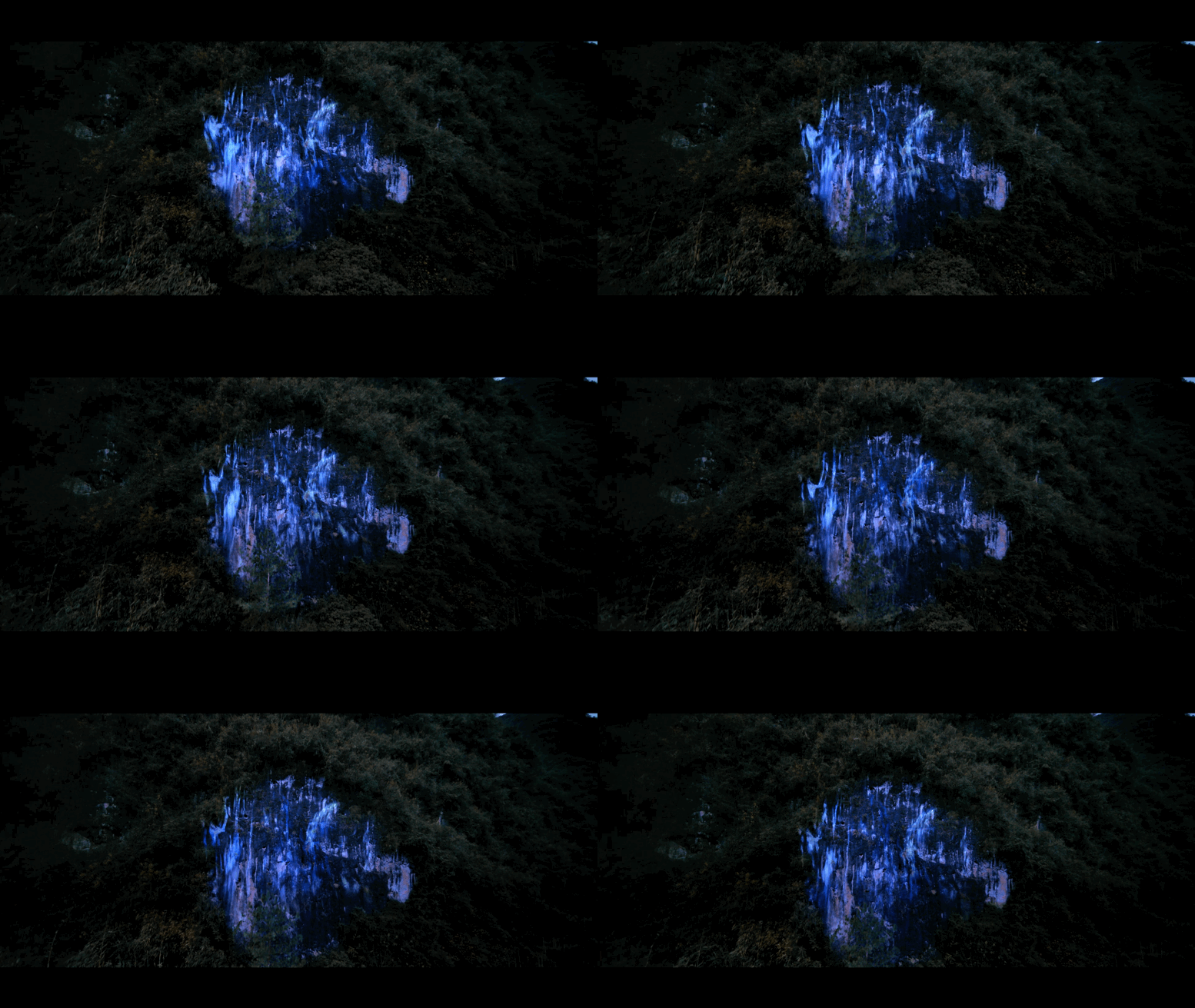
Liu Jiayu, In The Flow, 2020. ?Liu Jiayu Studio
Water is a motif that runs throughout Liu Jiayu’s work, its fluidity forging her metonymic plasticity, its amorphous expansiveness giving her freedom of creation, and its abundance nourishing her affinity with the Earth. For Liu Jiayu, water is a formal device to explore material possibilities as well as a conceptual apparatus signifying meaning’s evocation. Water comes in varied states, configurations, and even materials: rivers, streams, waterfalls and ocean waves.
Ocean Wave (2017) is fluidity concretized, transposing gravitational pull into digital tidal flux and spumes becoming light itself — wave and wavelength, short and long, entwined. Fifty motorized carbon-fiber rails, guided by real-time camera recognition and a self-developed algorithm, track the edge of each wave and convert its motion into corresponding shifts in light, brightness, and color, forming LED matrices that rhythmically rise and ebb in complex kinetic movement. Captured through long exposures of ten to fifteen seconds, the wave's passage leaves behind a visible trail of light, transmuting the otherwise invisible exchange of gravity, motion, and time into a tangible, sensory language. Liu Jiayu thus extends a natural phenomenon into a synthetic experience that invites meditation on the intermingling of nature and technology, its poetics, and, at the same time, implicitly alerts us to the dissolution of the boundary between the two.
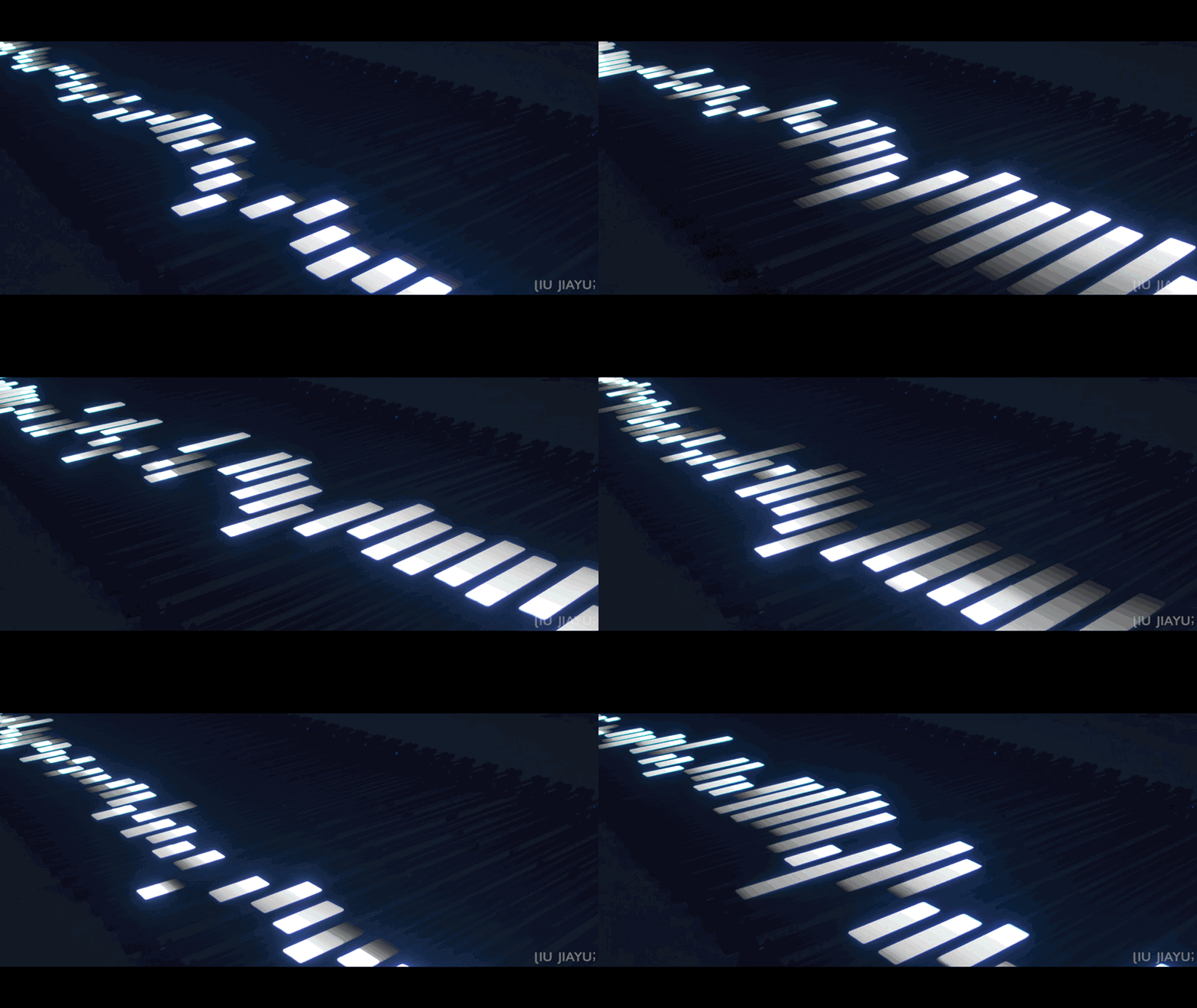
Liu Jiayu, Ocean Wave, 2017. ?Liu Jiayu Studio
At its very core, digital art is made of codes — words that execute and enliven. Liu Jiayu reveals the substrate of movement and light that characterizes the work in its bare manifestation. With Waves of Code (2023), flow and wave are no longer representations of natural phenomena but the direct output of code generating itself through the workings of the machine. Using GPT to generate p5.js code, Liu Jiayu builds a grid-based system through which the machine renders its own perceptual logic in real time: 221 LED panels, translating wind speed, direction, and sunlight reflection into a continuously shifting visual field, with a central mirror extending physical space into a virtual horizon. Artificial intelligence, for better or worse, is what now defines the human condition at the juncture of symbiosis or alienation. Liu Jiayu, an artist deeply invested in reconciling the dichotomy of machine and human, organic and inorganic, here gives agency to an AI model for comprehension and generation — Waves of Code therefore becomes the site where that reconciliation is enacted and tested.
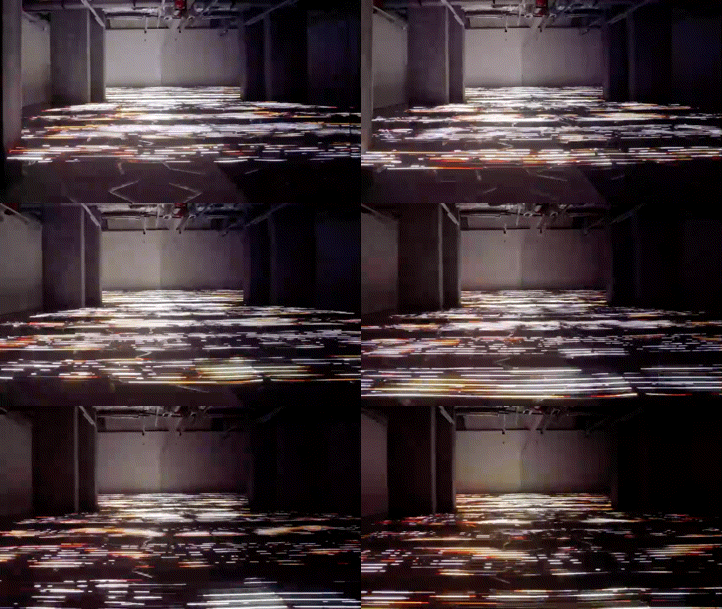
Liu Jiayu, Waves of Code, 2023. ?Liu Jiayu Studio
As I have noted in the opening of this text, Liu Jiayu belongs to the third generation of Chinese media art, the Generation Y that is born digital, global in perspective, and planetary in outlook. Motion, as a foundation of media art in her practice, is not only movement in action and interaction, but an agentic expression in and of itself — one in which ecology extends from mountains, rivers, oceans, and skies to computer code, silicon apparatus, datascape, and simulation: what Erich H?rl terms "general ecology" (H?rl 2017). That is why her practice is deeply grounded in a cosmological register of eco-art and an eco-feminist sensibility of care and tenderness for nature while at the same time seeing the computational terrain as another dimension of nature.
This sensibility finds its philosophical home in Iris Murdoch's notion of "unselfing" (Murdoch 1970) — the discipline of attention by which the self's claims on the world are quieted, allowing what is other to be seen as it is rather than as instrument or mirror. Liu Jiayu's practice neither anthropomorphizes the machine nor instrumentalizes nature; it holds both in a posture closer to María Puig de la Bellacasa's account of care as a form of labor performed with rather than upon the world (Puig de la Bellacasa 2017), and to the Zhuangzian wanderer who moves through things without seeking to master them (Zhuangzi, trans. Watson 2013). Wind, sunlight, tide, and silicon are treated, in this light, not as resources to be rendered legible, but as companions in an unfinished conversation between perception and matter.
While Liu Jiayu's conceptual framework resonates with the discourse of speculative design and speculative realism at its epistemic foundation, she employs light as her formal device, with which she has developed a poetic vocabulary of her own, articulated across highly idiosyncratic projection mappings, interactive installations, and machine-generated spectra that traverse mountains and rivers, imagined or embedded, artful or artificial. If what is today known as the Art of Light and Space, Ambient Art, and Environmental Art designates a group of artists of Southern California origin as the forerunners of Light Art, that tradition is now being carried on, as it were, by a younger generation whose primary medium is no longer the fluorescent light of the industrial age, or translucent and reflective material crafting spatial-temporal ambiguity, but its digital successor of LEDs and pixel luminosity augmented by algorithmic agility — yet the ethos of embracing nature and creating a heightened perceptual awareness of the environment, underscored, in particular today, by climatic uncertainty and ecological responsibility, remains largely unchanged. Liu Jiayu is among this lineage of media artists in their formal investigations on light and movement, space and time. And some of her audacious attempts to engage mountains and rivers, oceans and forests further exemplify her intuitive affinity with a unique tradition of Land Art created by women artists such as Nancy Holt, Lita Albuquerque, and Agnes Denes, whose monumental scale is not only a magnitude of size, but also a precursor to the more-than-human sensibility grounded in the nascent awareness of ecological and environmental precarity.
Her most monumentally ambitious project to date is arguably Treasure of Nature (2023), which transforms three decommissioned oil tanks — once geological relics of the energy age — into vessels of poetic regeneration. Across two of the tanks, digitally generated imagery of glaciers and flowing rivers is projected onto their outer surfaces, visible only after dark, while their interiors hold a meditative environment of simulated water and melting ice, circulating continuously between inside and out. The third tank reverses this logic: here, a river extends from the exterior into the interior, where light and shadow move across the walls in a slow choreography of renewal. Unfolding as a single narrative across all three — from origin, to growth, toward an imagined future — the work is grounded in real environmental data, recasting the industrial ruin as what the artist calls "Earth as medium" (Liu, Treasure of Nature): a techno-ecological interface co-created by digital systems, energy, and matter.
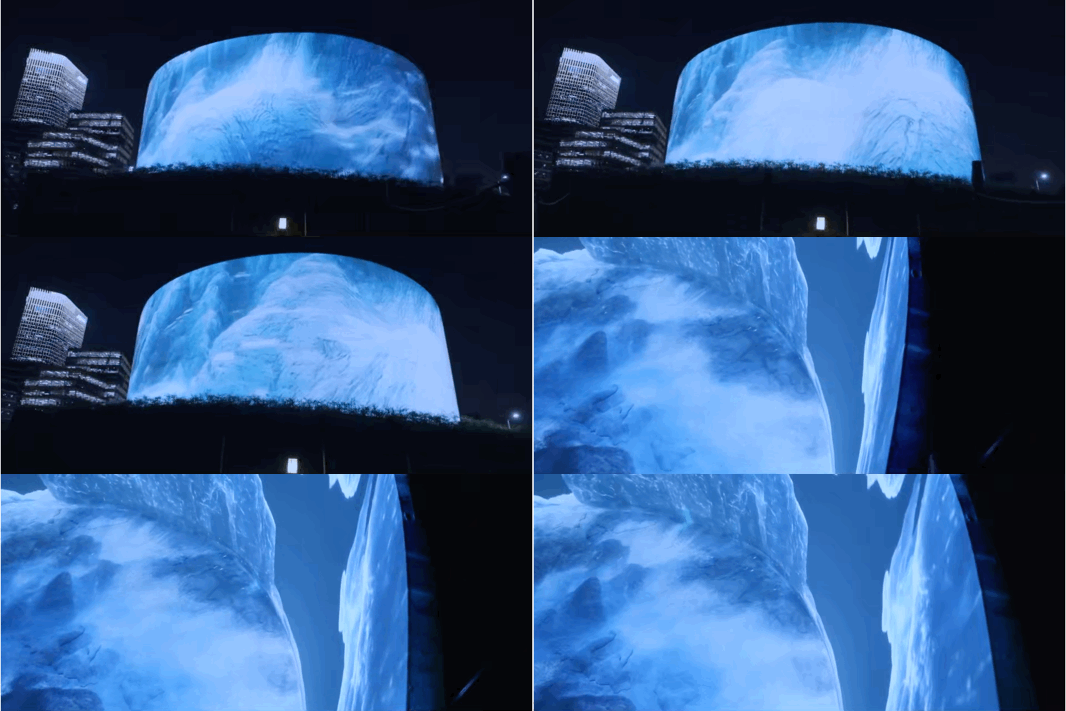
Liu Jiayu, Treasure of Nature, 2023. ?Liu Jiayu Studio
Liu Jiayu's art is digitally celestial and more-than-human in scale, alluding to a new dimension of grand narrative in which nature regains agency through motion, action, and interaction. Perhaps, her true medium is neither light nor code, but Earth systems rendered computationally perceptible.
Notes
[1] Motion Is Action: 35 Years of Chinese Media Art, curated by Zhang Ga, BY ART MATTERS, Hangzhou, 2023, surveying Chinese media art from 1988–2023 with 79 works by 72 artists across generations. Liu Jiayu's The Side Valley (2018) was included in the third chapter, Motion as Agency.
[2] The Ballad of Generation Y [Y时代之歌], curated by Zhang Ga, OCAT Shanghai, 6 December 2015 – 22 February 2016. Participating artists: Guo Cheng + Chen Yiyun, Guo Xi + Zhang Jianling, Lin Ke, Liu Jiayu, Liu Xin, Miao Ying, Shen Xin, Ye Funa.
References
H?rl, Erich, ed., with James Edward Burton. General Ecology: The New Ecological Paradigm. London: Bloomsbury Academic, 2017.
Liu, Jiayu. "Treasure of Nature." Jiayuliu’s Studio. Accessed June 24, 2026. https://www.jiayuliu.studio/2023-treasure-of-nature.
Murdoch, Iris. The Sovereignty of Good. London: Routledge, 1970.
Puig de la Bellacasa, María. Matters of Care: Speculative Ethics in More Than Human Worlds. Minneapolis: University of Minnesota Press, 2017.
Zhuangzi. The Complete Works of Zhuangzi. Translated by Burton Watson. New York: Columbia University Press, 2013.
About the Author
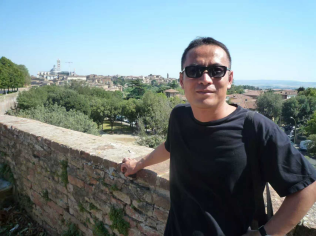
ZHANG Ga
curator
Distinguished Professor, Central Academy of Fine Arts
Swipe for more

双曜 / Still, Life:
刘佳玉个展
2026.9.25-2027.3.31
北京市朝阳区798艺术区
创意广场798CUBE
策展人:尤西·帕里卡
艺术技术顾问:弗雷德里克·福尔·莱马里
出品:北京七九八文化科技有限公司
主办:798CUBE


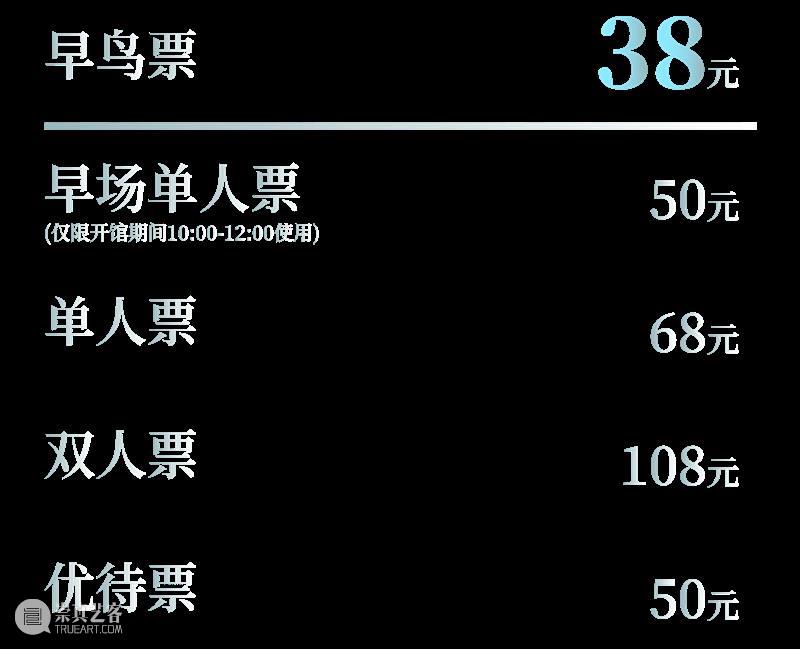
早鸟票售卖时间截止至9月24日24点

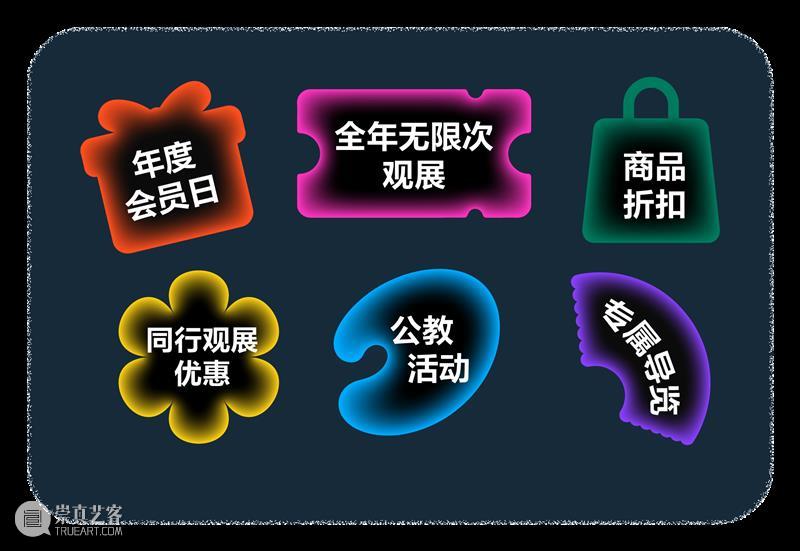
798CUBE致力于艺术、科学与科技的深度融合,旨在推动科技与艺术的跨界发展,成为连接国际艺术资源与公众的桥梁。作为国内少数完全按国际艺术机构标准设计和建造的艺术平台,798CUBE坐落于北京798艺术区的核心地带,建筑面积3600平方米,由中国当代著名建筑师朱锫设计,充分展现了科技、艺术与工业遗产的独特结合。798CUBE秉承“探索未知之境Into the Unknown”的理念,持续探索和推动科技与艺术的结合,打造一个面向大众,链接国际优质艺术资源与公众的平台,在新兴科技与前卫艺术孕育的语境中启发大众,并愿意持续、深入地参与到世界范围内的艺术语境之中。

 {{newsData.good_count}}

 {{newsData.transfer_count}}


 {{item.good_count}}k
已展示全部
{{item.publisher_name}} 发布了 文章
{{item.title}}
更多功能等你开启...


 分享