
胶囊|丁至:蜜蜜
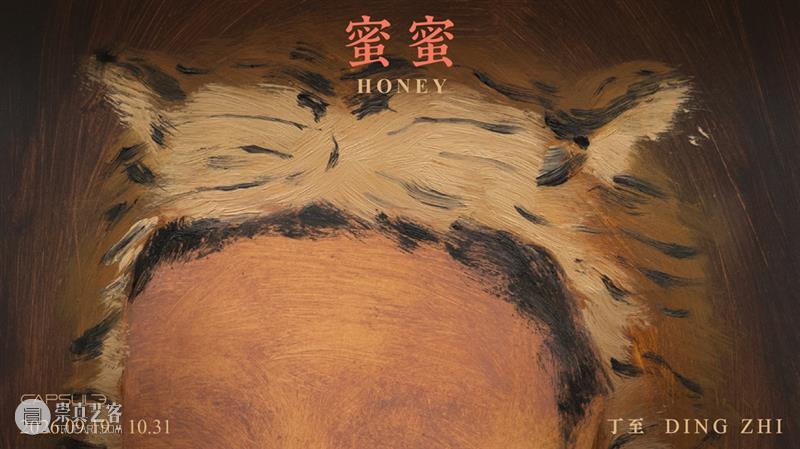
丁至:蜜蜜
Ding Zhi: Honey
展期 Dates
2026.09.19 - 10.31
开幕 Opening
2026.09.19 15:00 - 20:00
地址 Address
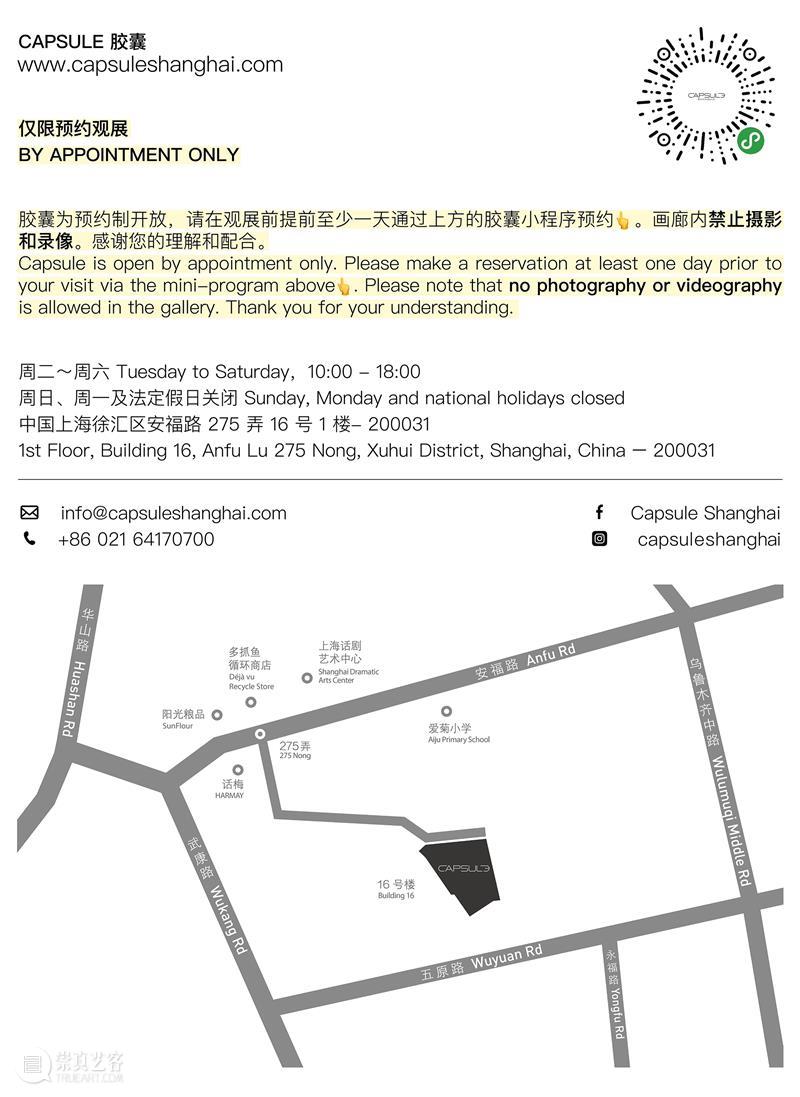
胶囊,上海徐汇区安福路275弄16号1层
Capsule, 1st Floor, Building 16, Anfu Lu 275 Nong, Xuhui District, Shanghai, China
胶囊欣然呈现丁至(1992年生于中国江西九江)于画廊的首次个展“蜜蜜”,展出艺术家近期创作的布面及木板油画。作品借用儿童读物、连环画与通俗媒体中熟悉而直接的视觉语言,将看似稚拙可亲的人物置于悬而未决的叙事情境中。画中人物不断观察、伪装、躲藏、追逐,并借助粗糙却暂时有效的道具完成自己的任务。这些行动既滑稽又郑重,既可能出于处境的迫使,也包含人物主动进入幻觉、赋予自身力量的时刻。可爱与荒诞由此不再只是作品的表面气质,而成为感受身份、欲望与力量关系的入口。画中人物的行动映照出普通个体如何在一套并非为自己设计、却不得不参与其中的系统里应对和周旋。作品承载着艺术家的个人经历,亦折射出平凡人在世间寻找自己位置时所经历的窘境、挫败、自得和坚定。
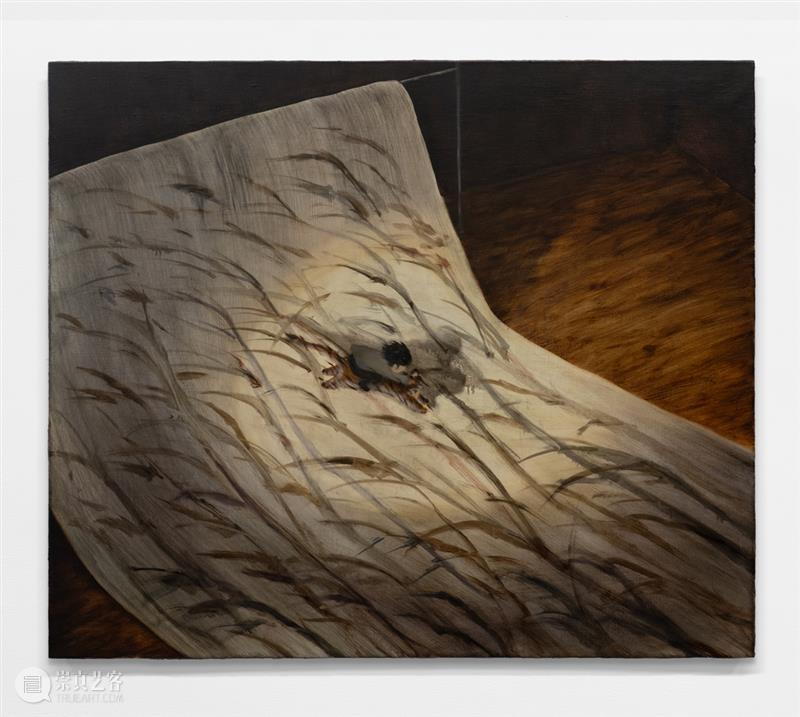
Ding Zhi 丁至 | Chana Star 4 ?安之星 4 | 2026 | oil on linen 亚麻布?油画 | 86.5 x 101.7 cm; 34 x 40 in
撰文:丁至
我想先和你说说雅俗共赏。我不想讲太多逻辑。
雅俗共赏是一个奇怪的词,一个褒义词却常给创作者带来自卑和负担。我不想无端的解读为创作者的傲慢——也许只是一个严格要求自己的创作者,太害怕陷入一种“无趣”和“复制”的习惯,太渴望被看见。
昨天我在挂画的时候,范师傅突然转头对我说:“你这些小画还蛮逼真漂亮的。”我不想自大又故作某种慈悲的说:“我的作品打动了一个也许不是艺术展览上常见的观众,对我来说是一种别样的收获。”我讨厌别人这样说!
我想到的是我的父亲,那个忧思多虑有点自卑的中年男人——“如果我爸来的话,那他应该也会喜欢。”之后的一瞬,某种作为艺术创作者的傲娇告诉我:“这真的是好事嘛?能轻易被这样的‘消费’是好事吗?”然而这次,我似乎明了了不少。这不一定是绝对的好事,但肯定不是坏事——因为我也是范师傅,也是我父亲,也是一个带着一点不懂和自卑的局外人。
必须承认的是,范师傅对我的赞美确实带给我一种非常不稳定的自得。这种感觉挥之不去,甚至比开幕时听到的许多客气话让我心颤。以至于,我不得不去怀疑——会不会,有时候,它因为是某种坦诚,才能击穿了很多东西达到雅俗共赏。
我相信范师傅说的“漂亮”不是艺术家口中的“技法好,材料好,视觉特别”,也不是大众意义上的“视觉和谐舒适的漂亮”。范师傅口中的漂亮,我希望是他觉得有一点喜欢,有一点连接。
初中的时候,我来上海与一个美国高中的校长见面。全英文交流的高雅五星酒店,安静整洁的街道让我觉得很有压力——我已无暇顾及自己喜不喜欢那个学校,只知道这个压力让我异常痛苦。站在这里的我太过突兀!而母亲还非要拽着我去一个专门卖外语书的书店买书,我都不知道意义在哪里!店员正在看的书也是外文的,我非常害怕母亲责骂我。突然看到了“哈利波特”——这个我认识!这个故事我也看过,买个哈利波特的英文版我肯定看得懂。那一刻,上海的天拨云见日,去美国好像也没那么可怕。至少我可以先装一阵子。
观察和伪装是个重要的生活技能。尤其去了美国以后,为了不露出不知道什么的马脚,不要破坏我岌岌可危的自尊心,观察是我去到所有环境里必须做的事情。至少先不要突兀,最好能伪装到顺利融入——我的条件不允许我做到真材实料,而自尊心不允许我彻底臣服。伪装这门卡在中间的技艺,我悄悄淬炼。
直到混入了更大更好的地方,这场骑虎狂奔似乎始终没有停下。(也许大家越来越善良,看穿不拆穿的人越来越多。)回到家乡的那一刻,或者需要我诚实的那一刻,我依然是城镇女孩小丁,琼瑶电视剧里的古诗词是我的文学启蒙的小丁——“红嘴绿鹦哥”来形容菠菜,大雅!
这样的我,创作出了这样的作品,是一种诚实。
甚至,如果这个作品,创作它的,运输它的,悬挂它的,观赏它的,甚至购买它的,在某一刻都觉得有一点事关自己,是不是也是我这样的创作者的一种成就——我不但没有忘本,我还破圈了。
所以,小明即使是一个“符号”也可以是你我他。而我的经验告诉我,我就是这样的一个小明,只有在数人数的时候,才会发现我的存在与消失会让数字出现一些细微差别。当小明成为故事的主角,你会发现,小明是谁、小明如何想的根本不重要,甚至小明是不是一个真人都不重要,他只是需要存在,然后让故事展开。但你还是会难过,你想去了解小明,但小明和世界都不给你媒介。
这样的小明可以是吸完血就跑的蚊子。因为没有力量的生物,最懂得逃跑的艺术。然而小明又是有着复杂情绪的个体,他会在吸饱血即将逃脱之时,狡黠一笑,你能说这一笑不是一个权力的反转吗。当然,小明的“功夫”也不能细看,蚊子的吸血口器是被绳子固定在脸上的简易装置,猛虎的套装穿上以后,也依然会在强光之下无处遁形,变得局促滑稽。
于是,某种信念感也变得重要。自欺才能欺人。如果不能获得某种正当却又被渴望的权力,不如先来个自己的版本——拿着剪刀变成的宝剑喊着去捉树妖,谁是树妖不重要。
先动起来,先给自己一个理由。
跟着幻觉走,跟着某种自己赋予的任务和使命走。毕竟幻觉早已成为日常。
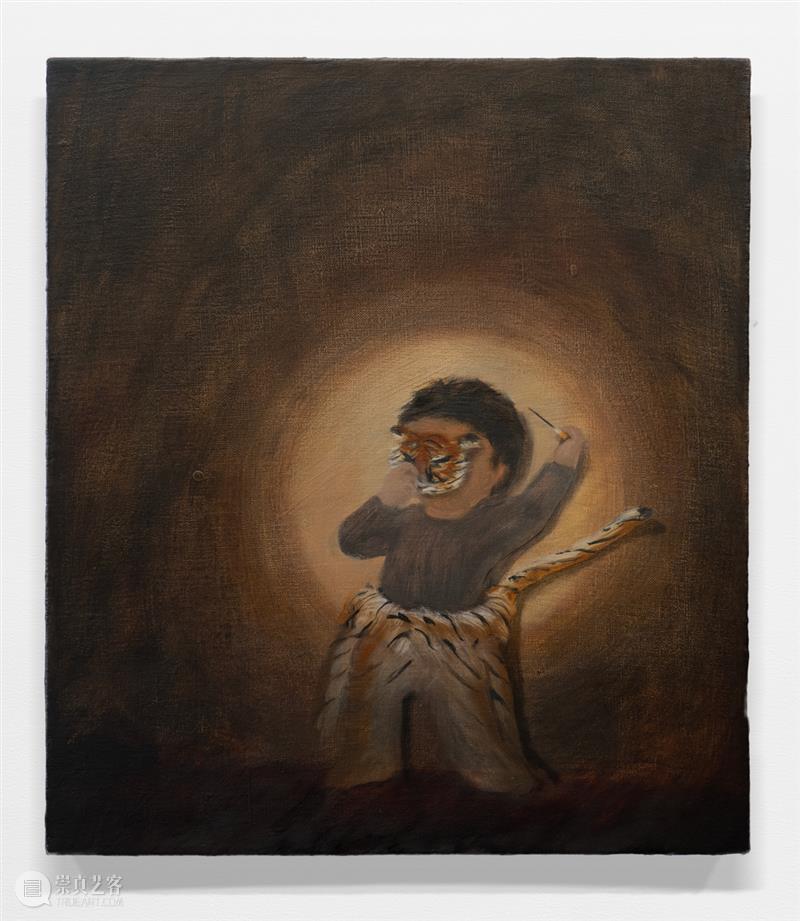
Ding Zhi 丁至 | Chana Star 5: Tiny Tiny Hate ?安之星 5:??的恨 | 2026 | oil on linen 亚麻布?油画 | 43 x 38 cm; 17 x 15 in
Capsule is pleased to present Honey, Ding Zhi’s (b. 1992, Jiujiang, Jiangxi Province, China) first solo exhibition at the gallery, featuring her recent oil paintings on canvas and wood. Drawing on the familiar and direct visual language of children’s picture books, comic strips, and popular media, the artist situates unassuming and relatable figures within narratives that remain unresolved. Her protagonists carry out missions through observation, disguise, hiding, and pursuit, using crude yet temporarily effective props. Their actions are at once comic and earnest: sometimes compelled by circumstance, at other moments prompted by a voluntary entry into illusion and a desire to empower themselves. Cuteness and absurdity, therefore, are no longer merely stylized elements, but portals into questions of identity, desire, and power dynamics. The works reveal how ordinary individuals navigate systems that were not designed for them, yet in which they must nevertheless participate. Rooted in her personal experiences, Ding’s paintings reflect the predicament, failures, self-contentment, and quiet resilience that accompany the search for one’s place in the world.
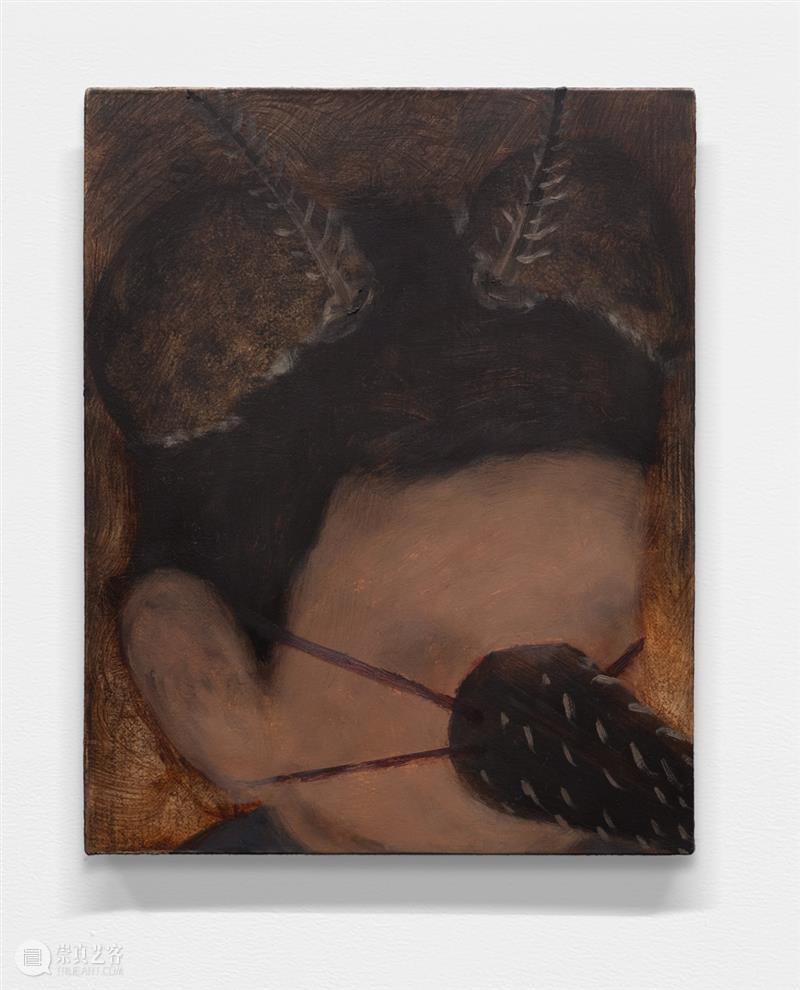
Ding Zhi 丁至 | Xiaoming 14 小明 14 | 2026 | oil on linen 亚麻布面油画 | 25.4 x 20.32 cm; 10 x 8 in
Text by Ding Zhi
Let me start with likability, the kind that appeals to both the highbrow and the lowbrow. I won’t get too logical about it.
It’s a slippery phrase. It’s meant as a compliment, yet somehow it often gives artists a sense of shame and dread. I don’t want to write that off as artist arrogance. Maybe it’s simply what happens to creative minds who hold themselves to a certain standard, who are afraid of sliding into the “boring” or the “derivative,” who desperately want to be seen.
Yesterday, while I was putting up the show, the art handler, Mr. Fan, turned to me and said, “These little paintings of yours are quite realistic and pretty.” And now I don’t want to be the person who puffs up and puts on some air of compassion by saying, “My work has touched someone who perhaps isn’t the usual kind of visitor at an art exhibition. That’s an unexpected reward.” I hate when people say things like that!
What I actually thought of was my father. That overthinking, quietly anxious, slightly insecure middle-aged man. “If my dad came, he’d probably like these too.” And then, a half second later, that slightly snooty voice in me—the artist voice—kicked in: “Is that really a good thing? Is it really good if something can be so easily ‘consumed’?” But this time, I think I have a clearer mind about it. It isn’t necessarily good, but it’s definitely not a bad thing—because I’m also Mr. Fan. I’m also my father. I’m also an outsider, a little confused and a little insecure.
And I have to admit: Mr. Fan’s compliment gave me a very unsteady kind of satisfaction. I couldn’t shake it. In fact, it rattled me more than many of the polite things people say at openings. To the point that I had to wonder: could it be that sometimes, precisely because something is honest, it manages to cut through all the layers and create a space where the “high” and the “low” can actually appreciate the same thing?
I believe what Mr. Fan meant by “pretty” is not the kind of “pretty” an artist talks about—solid technique, sensible materials, interesting visual language. Nor is it the kind of “pretty” that is simply pleasing to the eye. I hope what he meant was that he kind of liked it. That there was some kind of connection.
When I was in middle school, I came to Shanghai one day to meet the headmaster of an American high school. The whole conversation was in English, and took place in an elegant five-star hotel, on a quiet, spotless streets, and the pressure was enormous—I didn’t have the mental capacity to think about whether I even liked the school. I just knew this pressure was making me miserable. I felt so obviously out of place standing there! And then my mother insisted on dragging me to a bookstore that sold foreign-language books, and I could not for the life of me see the point! Even the clerk was reading a foreign-language book. I was terrified my mother was about to scold me. Then, suddenly, I saw Harry Potter. This one I know! I’ve read this story! I can surely handle the English version of Harry Potter. In that moment, the Shanghai sky seemed to clear, and going to the US didn’t seem quite so terrifying. At the very least, I could fake it for a while.
Observation and disguise are important life skills. Especially after I got to the States. In order not to reveal whatever it was I didn’t know, in order to protect my already precarious self-esteem, observing was something I had to do in every environment I entered. At the very least, I couldn’t look completely out of place. Ideally, I could disguise myself well enough to blend in. My circumstances didn’t allow me to be the real thing, and my pride wouldn’t let me fully surrender. So I quietly refined that craft in the middle: disguise.
And even after I made my way into bigger and better places, this mad ride—once you’re on the tiger, you might as well keep riding—never seemed to stop. (Maybe people have simply become more courteous. They see through you but decide not to say anything.) But whenever I go back to my hometown, or whenever I’m required to be honest, I’m still Little Ding, the small-town girl. Little Ding, whose literary interest began with the classical Chinese poetry sprinkled throughout Chiung Yao TV dramas—describing spinach as “the red-beaked green parrot”? How wonderfully elegant!
That’s me, and this is the kind of work I make. That’s my honesty.
And if, at some point, the person who made the work, those who shipped it, those who hung it, those who looked at it and even those who bought it felt there was kind of a connection—wouldn’t that also be an achievement for an artist like me? Not only did I not forget where I came from, I crossed the border.
So Xiao Ming (or John Doe)—even as a “symbol”—can be you, me, anyone. And my experience tells me that I am that Xiao Ming, the one whose presence only registers as a slight change in a number when somebody’s taking attendance. When Xiao Ming becomes the protagonist, you realize it doesn’t matter who he is or what he thinks, or even whether he’s a real person at all. He simply needs to exist so the story can unfold. And yet it still makes you sad. You want to get to know him, but neither Xiao Ming nor the world will offer you the means.
That Xiao Ming could be the mosquito that drinks its fill and flees. Creatures without power understand the art of running away better than anyone. And yet Xiao Ming is also an individual with complex feelings. Just as he is about to fly away, blood drunk and mission accomplished, he gives a sly little grin. How is that grin not a reversal of power? Of course, his craft doesn’t hold up under close inspection: the mosquito’s blood-sucking proboscis is a crude contraption strapped to his face; even if he dresses as a tiger, he still has nowhere to hide under the spotlight—awkward, ridiculous.
So a certain kind of faith becomes important. You have to fool yourself before you can fool anyone else. If you can’t get hold of some legitimate form of power, you might as well make your own version of it. Grab a pair of scissors, pretend they’re a sword, and go hunt the tree goblin. Who the tree goblin might be—it doesn’t matter.
Get moving first. Give yourself a reason first.
Follow the illusion. Follow whatever mission you’ve assigned yourself. After all, illusions have long since become part of everyday life.

 {{newsData.good_count}}

 {{newsData.transfer_count}}


 {{item.good_count}}k
已展示全部
{{item.publisher_name}} 发布了 文章
{{item.title}}
更多功能等你开启...


 分享